


Table of Contents

Singapore’s NEWater has been listed in Terra50, a new global, pioneering initiative spotlighting the 50 most impactful solutions addressing today’s most pressing climate challenges in cities. This article is written by Ana Villagordo Vegara, Project Manager and Explorer at Terra50. Click here for more details on Singapore’s NEWater.
What would happen if we stopped considering the water leaving our homes and industries as waste? For more than two decades, Singapore has demonstrated that wastewater can be transformed into water of exceptional quality. With NEWater, an advanced water reclamation system capable of meeting up to 40% of the country’s water demand, this city-state has turned a situation of vulnerability into an opportunity to rethink the urban water cycle.
When water scarcity forces us to rethink the system
Access to freshwater is one of the major challenges facing cities in the context of climate change. Rising temperatures, droughts, population growth and the demands of economic activity are increasing pressure on increasingly vulnerable water resources.
In Singapore, however, this concern is not new. With a small territory, high population density and limited domestic water resources, the country has historically relied heavily on water imports from neighbouring Malaysia. This dependence led Singapore to develop a strategy to diversify its water supply sources, known as the Four National Taps, led by PUB Singapore, the national authority responsible for water management.
The strategy combines four sources: water collected from local catchments and reservoirs, imported water, desalinated water and reclaimed water produced through the NEWater system. Rather than seeking a single solution to water scarcity, Singapore has opted to build a diversified, interconnected system that is less dependent on climatic conditions. Within this strategy, NEWater represents one of the most significant paradigm shifts: turning water that has already been used into a new source of supply.

From wastewater to high-quality water
Launched in 2003, NEWater is an advanced water reclamation system that transforms previously treated wastewater into exceptionally pure water, suitable for industrial applications and indirect integration into the drinking water supply.
The process begins with conventional wastewater treatment. However, instead of discharging the treated water into the receiving environment, it undergoes three additional purification stages:
- Microfiltration: removes suspended particles, bacteria and other impurities through filtration membranes.
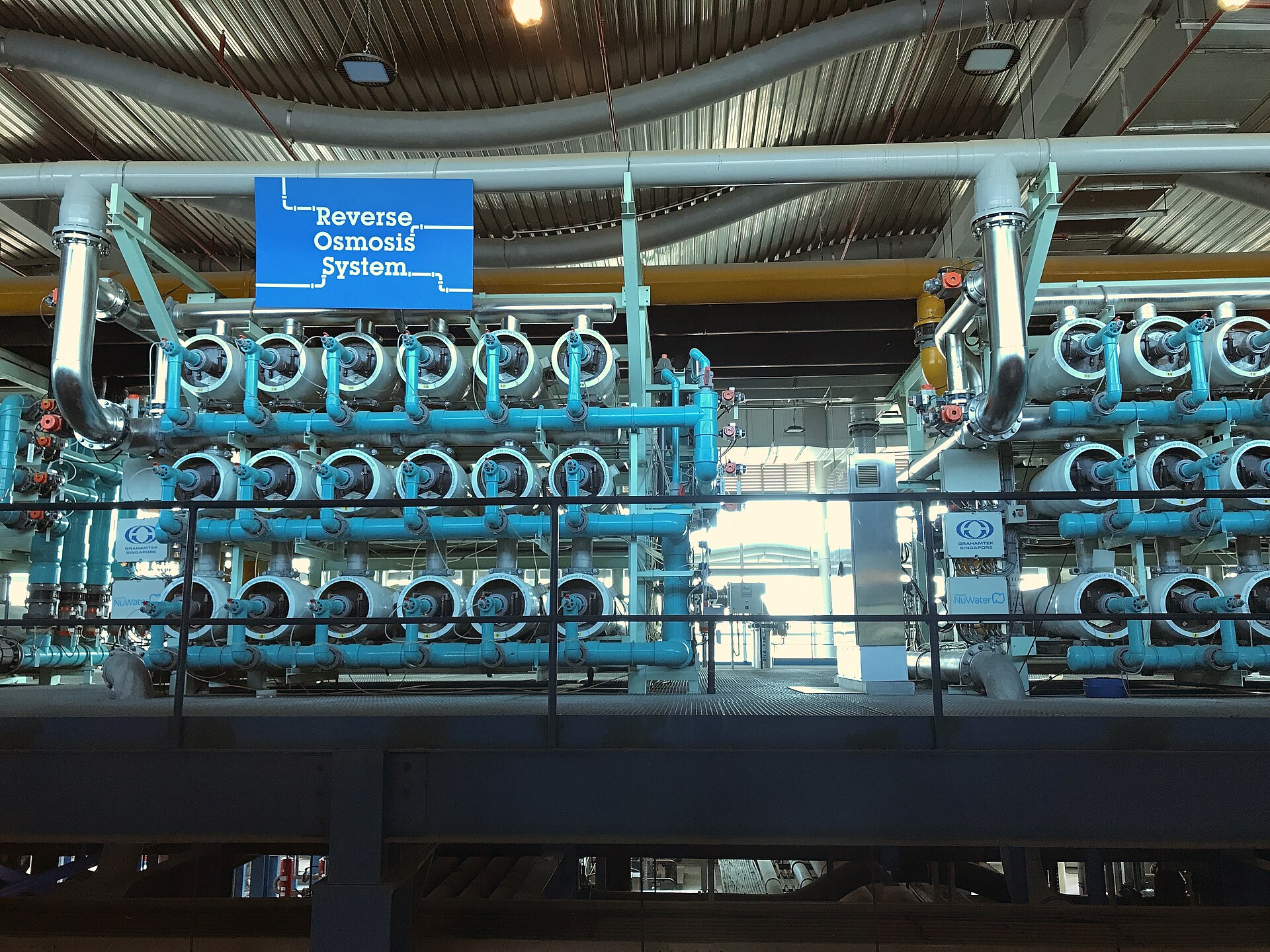
- Reverse osmosis: uses semipermeable membranes to remove dissolved salts, organic compounds and various microcontaminants.
- Ultraviolet disinfection: provides an additional safety barrier by inactivating pathogenic microorganisms.
The result is exceptionally high-quality water that, according to PUB Singapore, meets international drinking water quality standards and exceeds several of the parameters established by the World Health Organization.
The system also incorporates sensors, quality controls and safety protocols that enable continuous monitoring of the process. However, the innovation does not lie solely in the technologies used, many of which already existed before the project. What makes NEWater distinctive is the integration of these technologies into a large-scale water reclamation system, turning them into a structural component of an entire country’s water supply.
The same water, different uses
A significant proportion of the water produced by NEWater is used for industrial activities, particularly processes requiring exceptionally pure water, such as semiconductor manufacturing, as well as cooling systems. This application makes it possible to meet industrial needs without increasing pressure on conventional freshwater reserves.
Another proportion is allocated to indirect potable reuse. In this case, reclaimed water is introduced into reservoirs, where it is blended with other water resources before undergoing further treatment at drinking water treatment plants and entering the distribution network. This dual function makes it possible to adapt the use of water to the needs of the system and strengthen water supply security.
Not all urban activities require the same quality of water, nor do all water sources need to have the same origin. Managing water resources with this diversity of uses in mind allows cities to make better use of them and reduce their dependence on conventional sources.
A water source that is less dependent on rainfall
NEWater currently has the capacity to meet up to 40% of Singapore’s total water demand, and the country’s water strategy anticipates that this proportion could reach 55% by 2060. According to the information gathered, the system, which has been progressively expanded since 2003, comprises four industrial-scale production plants.
These figures place NEWater well beyond a pilot project or an isolated intervention. It is a strategic infrastructure system that helps ensure the everyday functioning of a city-state with significant domestic and industrial needs.
One of its main advantages in the context of climate change is that the availability of reclaimed water does not depend directly on rainfall. As long as urban activity continues and wastewater is generated, there is a potential source of water that can be recovered. This does not mean that it is an unlimited source or entirely independent of the rest of the system. Its production requires energy, sanitation infrastructure, maintenance and appropriate management of available resources.
However, it helps reduce vulnerability to drought and diversify the sources of water consumed. In a context of climate uncertainty, water resilience depends not only on having more water available, but also on having more ways to obtain and reuse it.
From the technological challenge to the challenge of trust
One of the most interesting aspects of NEWater is that its success cannot be explained through engineering alone. Transforming wastewater into water suitable for human consumption is a technological challenge, but also a cultural, social and emotional one. Perceptions about the origin of water can generate reluctance, even when scientific testing confirms its quality. For this reason, the implementation of NEWater has been accompanied by awareness-raising, environmental education and public communication initiatives.
Explaining purification processes, communicating quality controls and making the system’s operation understandable have been important elements in building trust over time. The very name of the project, NEWater, helps change how this resource is perceived: rather than emphasising its origin as wastewater, it focuses on the new water generated through treatment.
Innovation also involves transforming society’s perception of what we previously considered waste. This lesson is particularly relevant for other cities considering incorporating potable reuse into their water strategies. Having the necessary technology does not, in itself, guarantee public acceptance of the solution. Transparency, trust in the responsible institutions and the ability to communicate both the benefits and the risks, as well as the control mechanisms in place, are just as important as the infrastructure itself.
Closing the water cycle also presents environmental challenges
NEWater represents a departure from the linear model of water management, based on extracting water, treating it for drinking, consuming it, treating the resulting wastewater and returning it to the environment. Advanced water reclamation makes it possible to recover some of this water and reintroduce it into the system, reducing the need to extract new resources and dependence on external sources.
However, it is important not to interpret this circularity as a process without environmental impacts. Advanced treatment technologies, particularly reverse osmosis, require energy, specialised equipment and membranes that need maintenance and replacement. The residual streams containing substances separated during purification must also be managed.
Therefore, the overall environmental performance of the system depends on factors such as the energy efficiency of the facilities, the source of the electricity consumed, the management of treatment waste and the available alternative sources of water supply.
The information gathered identifies a significant contribution to Singapore’s water security, but does not provide sufficient aggregated data to quantify the system’s energy balance, associated emissions or overall environmental impact throughout its life cycle.
A climate adaptation solution is not necessarily a mitigation solution. Water reclamation must therefore be accompanied by strategies for energy efficiency, reduced consumption and infrastructure decarbonisation.
From Singapore to other cities facing water scarcity
Singapore is not the only territory to have incorporated advanced water reclamation into its water supply strategies. In Orange County, California, the Groundwater Replenishment System uses reclaimed water to replenish aquifers. In Windhoek, Namibia, direct potable reuse has been a response to water scarcity for decades. Perth, Australia, has also developed groundwater replenishment systems using reclaimed water. Closer to home, Barcelona and its metropolitan area have incorporated water reclamation as a tool for addressing droughts and reducing pressure on conventional water resources.
All these experiences share the same principle, even though their technologies, scales and end uses differ: the water we have already used can become a strategic source of water resources.
What makes Singapore distinctive is that it has turned this principle into a long-term national policy, integrating water reuse into the planning of the entire water system. However, replicating NEWater does not necessarily mean building large reverse osmosis plants in every city. The feasibility of each project will depend on wastewater availability, the quality of sanitation infrastructure, water supply needs, energy costs, investment capacity, regulatory frameworks and public acceptance.
In some contexts, it may be more appropriate to reclaim water for irrigation, street cleaning or certain industrial applications without needing to achieve drinking water quality. The main transferable lesson from NEWater is therefore to incorporate water reuse into urban and territorial planning, rather than considering it solely an emergency response to drought.
What if cities stopped generating wastewater and started generating water resources?
For a long time, cities have organised their metabolism around a linear model: extracting resources from the environment, using them and returning them as waste. Climate change and resource scarcity are forcing us to question this model.
NEWater demonstrates that it is possible to reorganise a significant part of the urban water metabolism and transform a waste stream into a strategic resource. But it also reminds us that circularity does not depend exclusively on technology: it requires long-term planning, investment, institutional coordination, knowledge and public trust.
Water reclamation does not replace the need to reduce water consumption, protect aquatic ecosystems, prevent losses in distribution networks or ensure equitable access to this essential resource.
The aim is not to consume more water because we are now able to reclaim it, but to learn how to meet our needs while placing less pressure on natural resources.
Perhaps Singapore’s most interesting lesson is that climate adaptation also involves reconsidering how we define resources and waste. After all, water does not disappear when it leaves our homes. It is up to us to decide what value we give it, how we treat it and what path we allow it to follow through the city.
References
- PUB Singapore — NEWater
- PUB Singapore — NEWater Quality
- PUB Singapore — National Water Agency
- Our Future Water Intelligence — Singapore’s Four National Taps: Portfolio Diversification & 2061 Strategy
- Video — NEWater: A Singapore Success Story
»Click here for more details on Singapore’s NEWater.
»The images in this article were provided by Singapore’s NEWater.