


Table of Contents

Water Square Benthemplein, a project led by the City of Rotterdam and developed by De Urbanisten, has been listed in Terra50, a new global, pioneering initiative spotlighting the 50 most impactful solutions addressing today’s most pressing climate challenges in cities. This article is written by Ana Villagordo Vegara, Project Manager and Explorer at Terra50. Click here for more details on Water Square Benthemplein.
A square for playing, practising sports and meeting people that, during heavy rainfall, transforms into a temporary reservoir holding almost 1.8 million litres of water. In Rotterdam, Benthemplein demonstrates that climate adaptation does not have to remain hidden underground: it can become part of public space, improve everyday life and offer a new way of designing cities.
When cities run out of space for water
For decades, cities have treated rainwater as a problem to be removed as quickly as possible. Impermeable surfaces, sewers and underground storage tanks have shaped a model that works until rainfall exceeds the system’s capacity.
In Rotterdam, a city located largely below sea level, this challenge is particularly significant. Heavy rainfall can overwhelm the sewer network and cause urban flooding. With climate change, the need to manage these events is becoming increasingly urgent.
The conventional response would be to expand underground drainage infrastructure. But these projects require substantial investment and, once completed, remain virtually invisible to citizens.
What if, instead of hiding water, we turned it into an opportunity to transform public space? This is the question that inspired Water Square Benthemplein, one of the most emblematic examples of urban climate adaptation.
A square that changes function when it rains
The idea emerged in 2005, when Dutch design studio De Urbanisten presented the concept of the water square at the International Architecture Biennale Rotterdam.
The proposal was as simple as it was innovative: to design a public space that functions as a square during dry weather and as water retention infrastructure during rainfall events.
The concept gradually moved from experimentation into municipal planning and was incorporated into Rotterdam Waterplan 2 in 2007. Following several studies and a participatory design process, Benthemplein opened in December 2013.
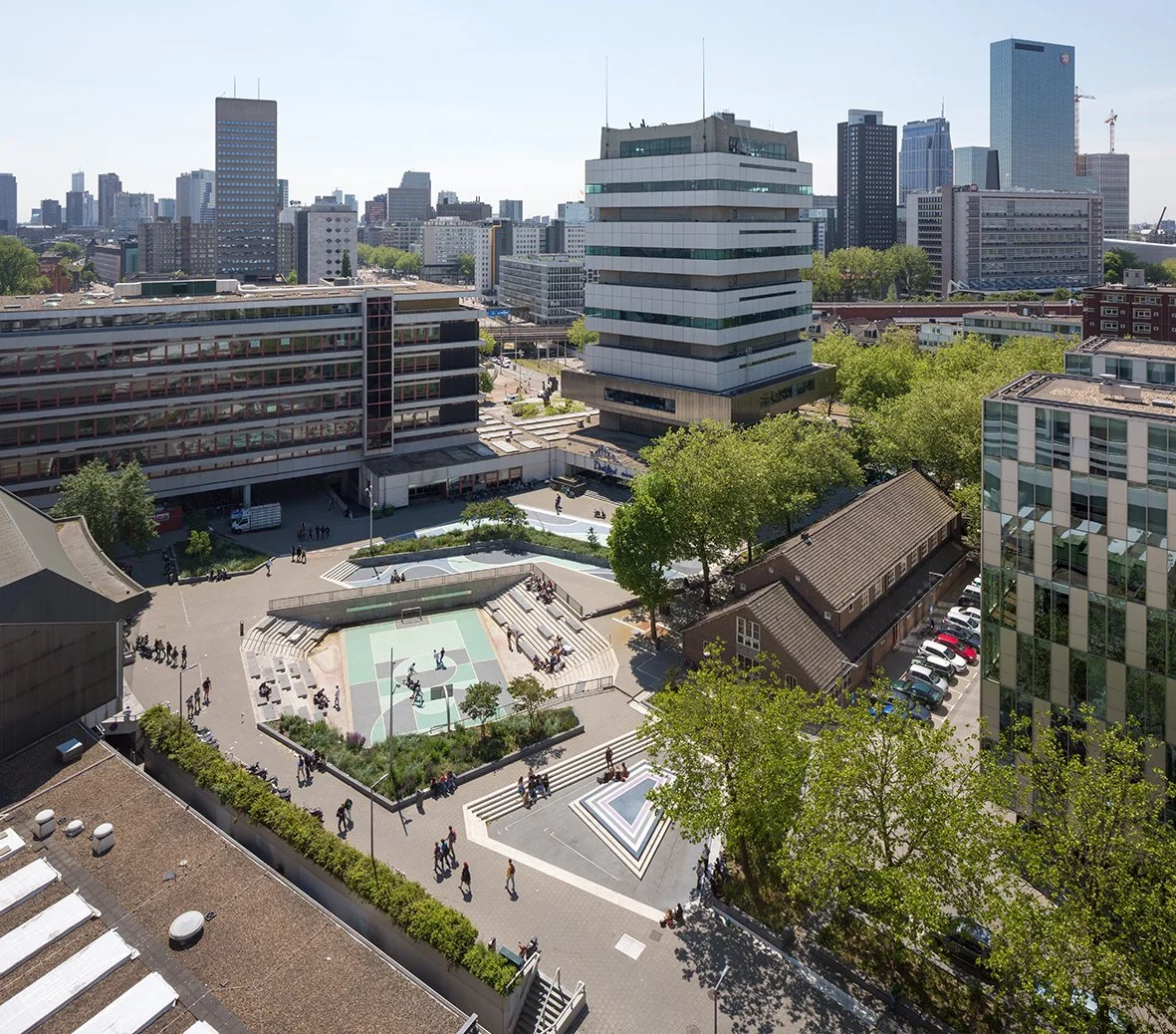
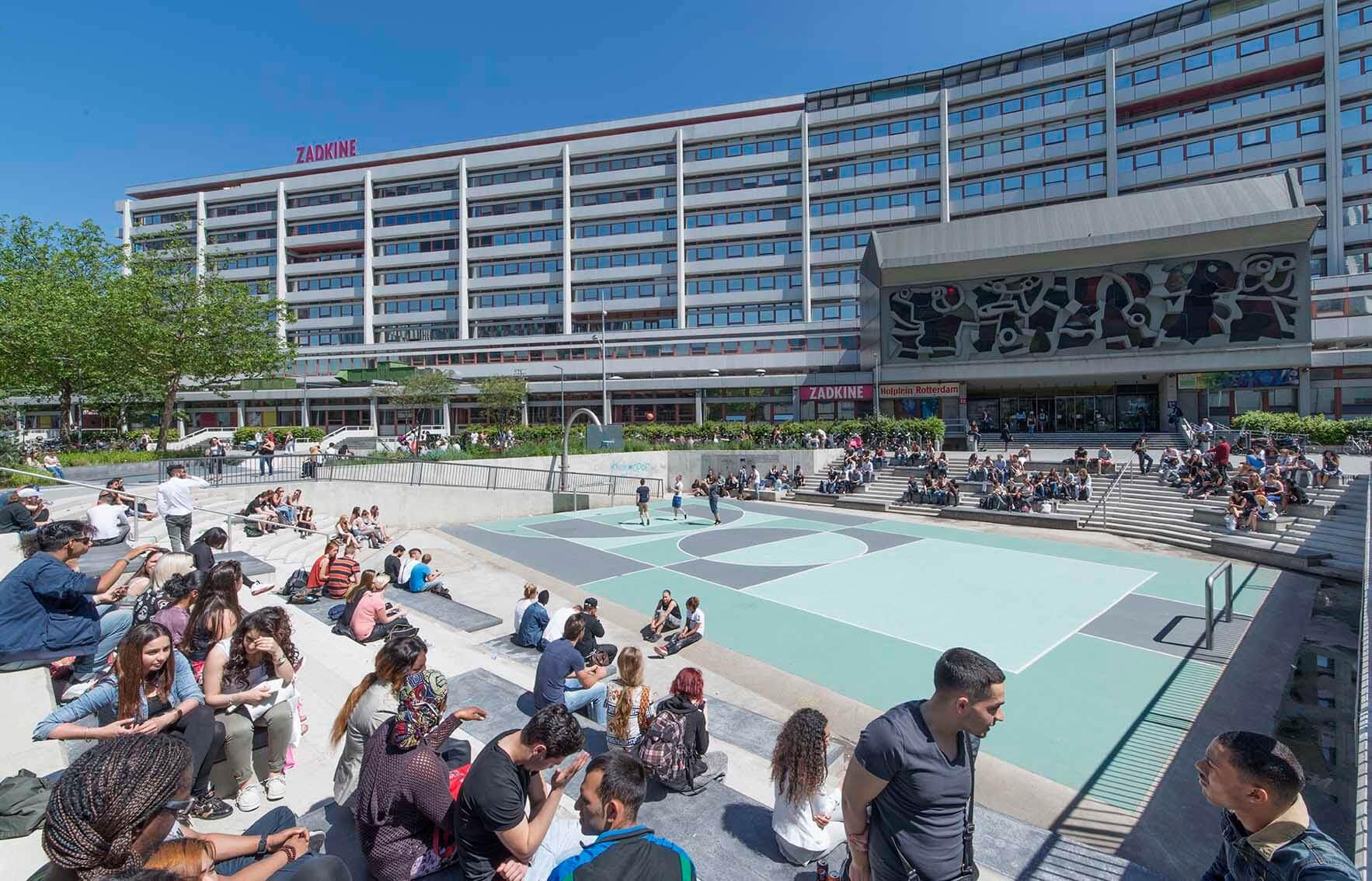
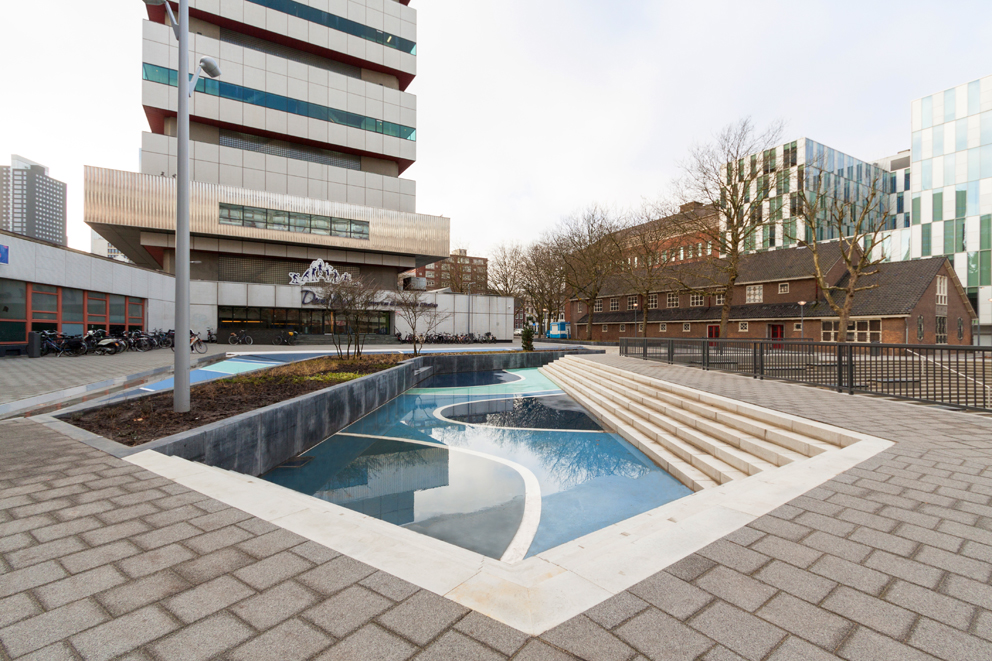
The square covers approximately 9,000 m² and incorporates three basins of different depths, with a combined capacity to store between 1.7 and 1.8 million litres of water.
The two shallower basins collect runoff from the immediate surroundings when it rains. The third, deeper basin fills only during intense or prolonged rainfall and receives water from a larger catchment area.
When it is not raining, these spaces become sports courts, play areas and meeting places. The central basin, with amphitheatre-style seating, provides space for sports and community activities.
Water flows into the square through stainless-steel channels that cross the site and, rather than being hidden, become part of its design. Different shades of blue on the pavement make the space’s water-management function visible, while trees, plants and landscaped areas help create a more pleasant environment.
The infrastructure does not disappear when the rain stops: it simply changes function.
Almost two million litres that do not flow directly into the sewer system
Benthemplein operates according to a fundamental principle of urban adaptation: temporarily retaining rainwater where it falls to prevent it from reaching drainage systems all at once. During heavy rainfall, the basins collect runoff and reduce pressure on the sewer network. The water is then gradually discharged into the city’s water system or infiltrates into the ground.
The design ensures that the basins empty within a maximum of 36 hours, preventing prolonged water stagnation and allowing the space to quickly return to its usual functions. Since its inauguration, the square has been activated during several heavy rainfall events, demonstrating the technical feasibility of the system.
However, no aggregated data are available to quantify the flood damage specifically avoided thanks to Benthemplein. Its demonstrated impact centres on its retention capacity, operational performance and contribution to relieving the drainage network during rainfall events.
The project also offers a different way of understanding climate infrastructure: the same space can provide protection against an environmental risk while generating everyday benefits for citizens.
Infrastructure designed with the people who use it
One of the most interesting aspects of the project is that the square’s transformation was not approached solely from the perspective of hydraulic engineering or architecture. During the design process, three participatory workshops were organised with students, teachers, church members, gym users and residents of the Agniese neighbourhood. Participants helped define what the space needed to offer: a dynamic square, particularly attractive to young people, with areas for sports, play, relaxation and social interaction. This made it possible to integrate water management with the neighbourhood’s social uses.
Participation was not limited to explaining an infrastructure project that had already been decided, but helped define how it should function when it was not raining, which is most of the time. This approach is particularly relevant because many climate adaptation infrastructures are designed primarily according to technical criteria, without fully exploring the opportunities they offer for social and urban improvement.
Benthemplein demonstrates that involving users in the design process can transform a hydraulic engineering project into a public space with its own identity.
A different way of financing public space
Benthemplein is also distinctive because of its financing model. The project cost approximately €4.5 million, funded mainly through water-management departments and innovation-related subsidies.
This approach made it possible to direct resources normally reserved for hydraulic infrastructure towards the creation of high-quality public space. It represents an important shift in perspective. If a square also functions as a water retention basin, its value cannot be assessed solely in terms of urban development costs or recreational benefits. The environmental service it provides must also be considered.
Investment in climate adaptation can simultaneously become investment in urban quality. This way of combining budgets and objectives is one of the project’s most transferable features, particularly for municipalities that need to adapt to climate change but have limited resources.
From Rotterdam to cities around the world
Benthemplein has become an international reference because it offers a solution that is understandable, visible and adaptable. Its influence extends beyond the construction of other water squares. It has also helped spread a new approach to integrating urban drainage into the design of streets, parks and public spaces.
In Rotterdam, the concept was also applied at Bellamyplein, in a smaller-scale intervention. Outside the Netherlands, the project has inspired initiatives such as Parque Hídrico La Quebradora in Mexico City, which combines rainwater management with public space, as well as projects developed in Surat, India.
Knowledge transfer between Rotterdam and Mexico City has even been the subject of academic research, demonstrating how urban solutions can circulate between cities and be adapted to different contexts.
But replicating Benthemplein does not mean reproducing a blue square with three basins. Each city must consider its rainfall patterns, topography, available catchment area, subsurface conditions and the social needs of its surroundings.
Resources must also be allocated to maintaining the channels, paved surfaces and drainage systems. In this sense, the project’s greatest value lies not in a particular architectural form, but in the principle behind it: ensuring that climate infrastructure serves more than one function and adds value to the city even when it is not responding to an emergency.
What if climate adaptation could also help reclaim public space?
We often imagine the infrastructure needed to address climate change as large, complex and expensive engineering works that only become visible when they fail. Benthemplein offers an alternative: making this infrastructure part of everyday life, something that citizens can understand, use and enjoy.
The square does not eliminate Rotterdam’s flood risk or replace the rest of the city’s drainage system. But it demonstrates that water management, public space design and social needs no longer have to be treated as separate issues.
Its transformative potential lies precisely in this integration: infrastructure that protects against heavy rainfall, creates spaces for social interaction, makes the water cycle visible and opens up new possibilities for financing and urban planning.
Perhaps Benthemplein’s most interesting lesson is that adapting cities to climate change is not only about preparing them to better withstand extreme events. It can also be an opportunity to make them more liveable, more inclusive and smarter in how they use space.
And this leads to a question that many cities should begin asking themselves: how much of the infrastructure we currently hide underground could be transformed into useful spaces for people?
References
- De Urbanisten — Water Square Benthemplein
- Landezine — Water Square Benthemplein by De Urbanisten
- Water Environment Federation — First Full-Scale Water Square Opens in Rotterdam
- German Institute of Development and Sustainability (IDOS) — Discussion Paper 1/2021
»Click here for more details on Water Square Benthemplein.
»The images in this article were provided by Water Square Benthemplein.