



Table of Contents
Author | Lucía Burbano
Germany is aiming for a Guinness World Record with the construction of what will become the tallest wind turbine in the world in Schipkau, an area historically linked to mining.
The project, developed by GICON in collaboration with the German innovation agency SPRIND, is expected to supply between 30 and 33 GWh of clean energy to around 7,500 homes. How do you build a wind turbine that will exceed 300 meters in height?
Features of Germany’s record breaking wind turbine
Since September 2024, GICON, a group of German engineering companies developing innovative renewable energy technologies, has been leading this project, which will raise the wind turbine to a height of 360 meters. This record breaking turbine will be able to capture stronger high altitude winds and will exceed the clean energy output of conventional wind turbines in the local wind farm by 220%.
The project will create a hybrid power plant combining two levels of wind turbines with a solar park to increase energy output fivefold and generate electricity more consistently, a major challenge in Germany since, according to Tagesspiegel, around 9.3 terawatt hours were wasted in 2023 due to transmission limitations.
A towering engineering project
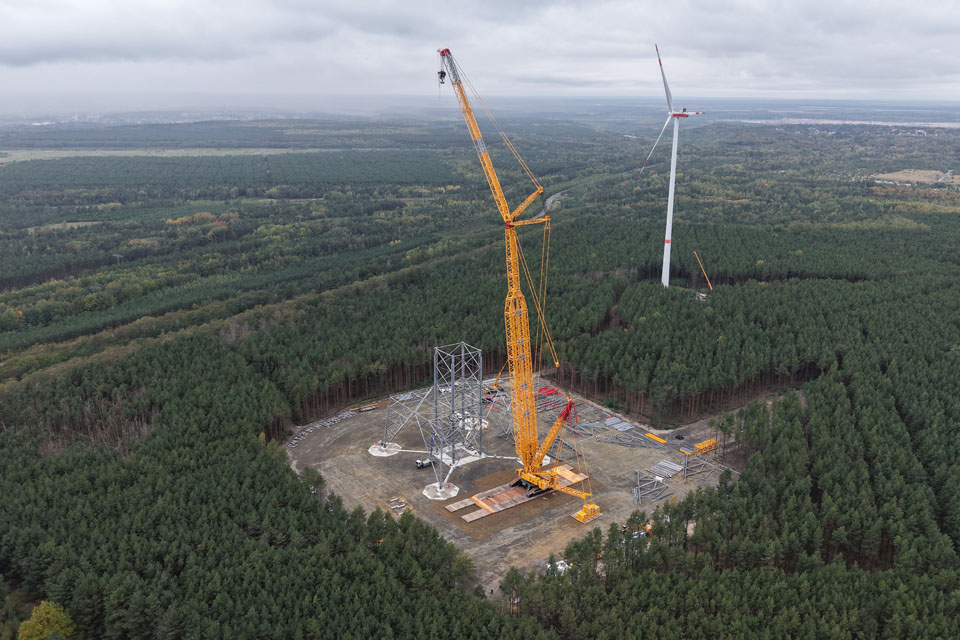
GICON explains that the lattice style design makes what will become the world’s tallest wind turbine a masterpiece of engineering.
Instead of the traditional cylindrical steel tower, the project uses a structure similar to high voltage transmission or radio towers because of the advantages it offers at extreme heights:
- Reduces wind load.
- Uses less steel to achieve the same rigidity.
- Distributes forces through triangulated elements.
- Provides better resistance to buckling in relation to its weight.
A pioneering telescopic lifting concept
However, beyond the lattice design, it is the telescopic lifting system that allows the turbine to reach this unprecedented height.
The design involves assembling the nacelle and rotor at an intermediate height of 150 meters, where cranes are still able to operate. A hydraulic system then lifts the rotor and nacelle vertically to the 300 meter tower height, which is normally beyond the operational limits of cranes when lifting heavy components at extreme altitudes.
GICON’s system breaks this barrier by allowing the tower to function as its own lifting mechanism.
Construction challenges of the German wind tower
Raising a structure made up of 2,000 tons of steel and 22,000 individual components using this telescopic system requires extremely precise control to avoid compromising the tower’s structural integrity. In addition, at 300 meters, the lateral forces generated by the wind are immense, exposing the tower to loading conditions very different from those experienced by conventional turbines.
The rotor diameter, at around 126 meters, is not unusually large for a modern wind turbine. In this case, however, the challenge lies in the relationship between the tower’s slender structure and its dynamic behavior.
Despite its complexity, the telescopic lifting system reduces long term costs because it eliminates the need for enormous cranes, which are in short supply and significantly increase the cost of projects of this kind.
After construction was paused at the end of 2025, work resumed in March 2026, and the turbine is expected to become operational by the end of the year.
Frequently asked questions about the world’s tallest wind turbine
Why is this wind turbine so tall?
At higher altitudes, winds are stronger and more stable, which can significantly increase electricity generation. The turbine hub will be positioned at around 300 meters, far higher than conventional onshore wind turbines.
How tall will it be?
The turbine is expected to reach a total height of around 365 meters, making it the tallest wind turbine ever built. This is comparable to a 100 story skyscraper.
Why is its engineering unique?
The project uses a giant lattice tower and a telescopic lifting system that raises the turbine components from inside the structure, avoiding the need for massive cranes at extreme heights.
When will it start generating electricity?
Current plans indicate that the turbine will begin operating by the end of 2026, although delays have occurred due to defective steel components. As this is also a prototype project, testing and certification may continue after initial operations begin.
What role does it play in Germany’s clean energy strategy?
The project forms part of Germany’s broader effort to replace coal and expand renewable electricity generation. It also serves as a testing ground to determine whether ultra tall turbines can generate onshore wind power more consistently and reduce reliance on fossil fuels.
Photographs | Unsplash/Karsten Würth, GICON