Table of Contents
Author | Elvira Esparza
The use of blockchain in energy trading drives microgrids by enabling a more decentralized and transparent market. The blockchain and energy market was valued at $3.1 billion in 2024 and is expected to exceed $103 billion by 2034. However, its growth faces regulatory uncertainty, as current regulations do not clearly address peer-to-peer energy trading, as they are designed for centralized systems.
What are microgrids and how do they contribute to renewable energy distribution?
Microgrids are small, local electrical networks that can operate either connected to the main grid or independently. They use renewable sources such as solar, wind, or biomass, along with storage systems (batteries) and smart management technologies. These microgrids help distribute renewable energy by enabling users to buy and sell energy directly between themselves without going through utility companies. For example, an individual with solar panels can sell their excess energy to another individual who needs it.
Managing these decentralized networks presents challenges related to energy distribution, transaction security, and real-time responsiveness to fluctuations in supply and demand. Blockchain offers a solution to these issues by securely and transparently recording transactions without intermediaries, reducing costs since there are no intermediaries involved.
How is the process conducted with blockchain?
The first requirement is that users, who are also energy producers (prosumers), must be physically connected through the microgrid and digitally connected via the internet or IoT network, since blockchain is a digital ledger. Energy flows between homes connected to the microgrid so if one user has excess energy, they can transfer it to another user who needs more. Thanks to smart meters, the energy entering and leaving each home can be accurately measured, ensuring the transaction reflects the reality.
To conduct energy exchanges, both users need to be connected to a blockchain-based digital platform. They must have a digital wallet where tokens or digital coins are stored, which also serves as their identity on the blockchain. Additionally, a specific app or software is required to track energy production and consumption, post energy offers and purchases and execute smart contracts.
The process is simple: the user with excess energy posts an offer, and the user who needs energy makes a purchase. The smart contract verifies that the seller has the energy available and the buyer has the necessary tokens to buy it; it then authorizes the transfer and automatically processes the payment in tokens, cryptocurrency, or traditional money. This way, the transaction occurs without intermediaries, and the contract is recorded on the blockchain.
What advantages does blockchain offer?
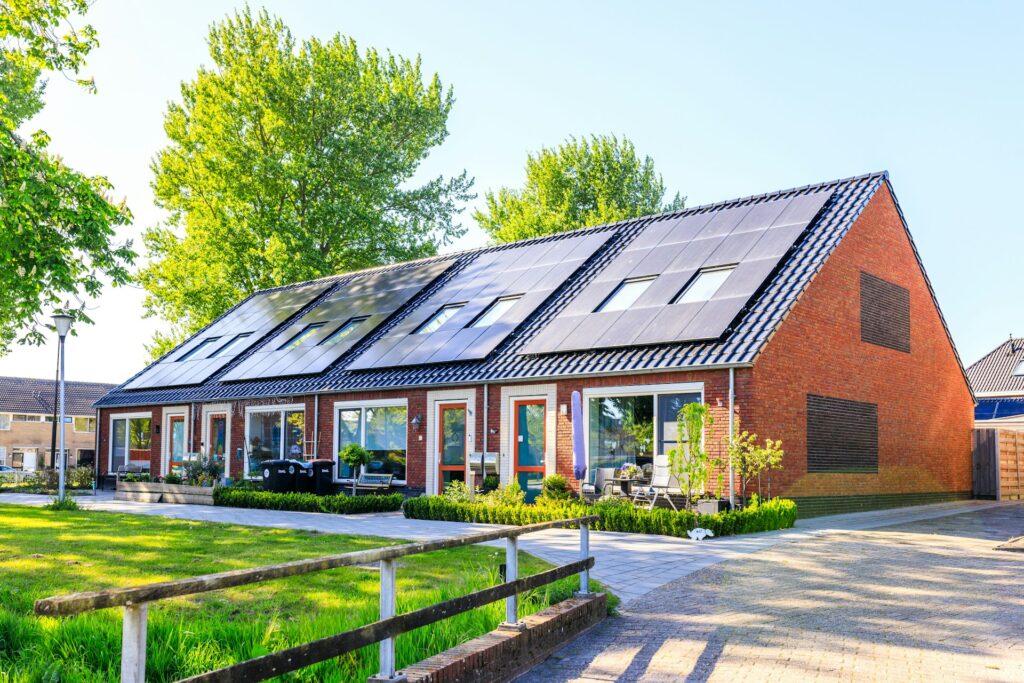
The main advantages of using blockchain can be summarized in four key points:
- Decentralization: It enables communities and individual producers and consumers to operate independently from utility companies.
- Sustainability: Blockchain enables traceability of energy sources, and microgrids promote the use of renewable energies, mainly solar and wind.
- Efficiency: This system minimizes energy losses during transmission and enhances energy resilience.
- Transparency: Fraud is impossible because every transaction is recorded on the blockchain and cannot be altered.
Which microgrids are using blockchain?
There are P2P energy microgrids operating through blockchain with promising results.
- In Australia, the startup Powerledger enables users in Perth to buy and sell excess solar energy. They use smart contracts to automate transactions, improving energy efficiency, lowering electricity bills, and encouraging the use of solar panels.
- In Brooklyn (USA), the LO3 Energy microgrid was a pioneer in using blockchain technology for energy. Residents with solar panels can sell their excess energy to other local consumers through smart contracts on Ethereum. Users have saved between 6% and 12% on their electricity bills, while producers have earned 18% to 37% more from selling their energy.
- In Estonia, the platform WePower has conducted large-scale energy tokenization using smart meters and the Estfeed data exchange platform. It is the first company to tokenize an entire power grid.
Photos | Kindel Media, Uitbundig