Table of Contents

Over Easy Solar has been listed in Terra50, a new global, pioneering initiative spotlighting the 50 most impactful solutions addressing today’s most pressing climate challenges in cities. This article was written by Ana Villagordo Vegara, Project Manager and Explorer at Terra50. Click here for more details on Over Easy Solar.
Cities have thousands of square metres of flat rooftops. We see them on industrial buildings, public facilities, logistics centres, offices and data centres. They may look like ideal spaces for generating solar energy, but many cannot support the weight of a conventional installation, cannot be penetrated or already serve another purpose, such as retaining water or supporting vegetation. Over Easy Solar starts with an apparently simple question: what if, instead of adapting all these rooftops to solar panels, we adapted the panels to the rooftops?
Solar photovoltaic energy has become an essential part of the energy transition. In dense urban environments, however, deploying it means addressing a basic question: where do we put it?
Building rooftops offer an obvious answer. They make it possible to generate electricity where it is consumed without occupying additional land, and can turn buildings that until now have only consumed energy into small hubs of distributed generation.
But a flat roof is not necessarily an available roof. Conventional photovoltaic systems often require tilted mounting structures, ballast to withstand wind loads or fixings that penetrate the roof. This can add too much weight for some existing buildings, interfere with waterproofing or make maintenance more difficult. And when it comes to green roofs, another contradiction emerges: we want more renewable energy, but we also need more urban vegetation, greater biodiversity and surfaces capable of managing stormwater. Do we have to choose?
Norwegian company Over Easy Solar has developed an unconventional answer: installing the panels vertically.
Changing the orientation to change what is possible
The system is called the VPV Unit and consists of small bifacial solar panels installed vertically. Instead of capturing solar radiation mainly through a tilted surface facing the sun, the photovoltaic cells can generate electricity from both sides.
But the innovation is not simply geometric. Each unit arrives on the roof almost fully assembled, with the panels, structure, cabling and necessary components already integrated. It does not require roof penetrations or the heavy ballast commonly used in many conventional installations. The system weighs approximately 12 kg/m² and, according to the company, can be installed in around 15 minutes per kWp, up to ten times faster than a conventional system.
Prefabrication therefore shifts a significant part of the complexity from the rooftop to the factory. Once the units reach the building, installation is more a matter of positioning and connecting components than constructing new infrastructure on the roof. This means that buildings with structural or technical constraints that might previously have been excluded from solar generation can now come into play.
The vertical configuration also changes when electricity is produced. Rather than concentrating a large share of generation around the middle of the day and during the months with the highest solar radiation, bifacial panels can generate proportionally more energy in the morning, in the evening and during winter. But this does not necessarily mean that they produce more energy in every situation. In fact, a vertical installation may generate less during certain periods in summer than a properly tilted conventional system. The point is different: it can offer a different generation profile and, above all, produce energy in places where the alternative might have been no photovoltaic installation at all.

Solar energy or urban greenery? Perhaps we do not have to choose
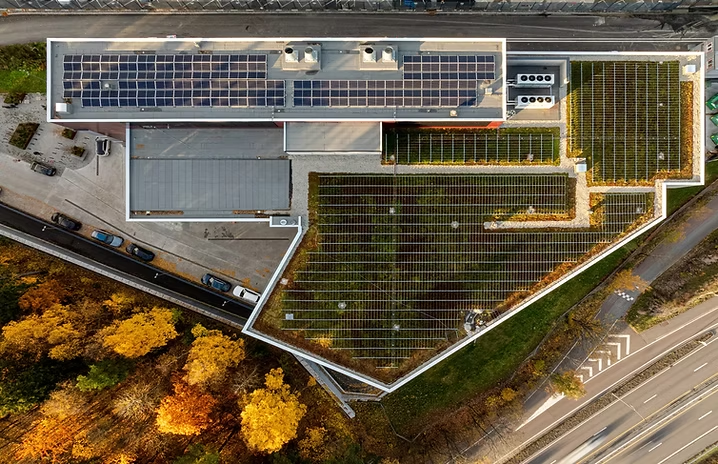
One of the most interesting applications of the system is on green roofs. Combining vegetation and photovoltaic panels is not new, but conventional systems can compete with plants for space, create significant shading or make maintenance more complicated. The vertical configuration leaves a much larger proportion of the roof surface free and accessible.
This makes it possible to think of the rooftop as multifunctional infrastructure: generating electricity, retaining stormwater, incorporating vegetation, supporting biodiversity and contributing to the building’s thermal performance, all on the same surface.
This is particularly relevant in cities where every square metre is competing for multiple uses. For a long time, we have thought about urban infrastructure in specialised terms: one space generates energy, another manages water and another provides greenery. Climate pressures are increasingly forcing us to ask how many functions a single piece of infrastructure can perform simultaneously. Over Easy Solar works with companies specialising in green roofs, including Sempergreen, to integrate the two solutions.
There is also another practical consideration: keeping the panels vertical reduces the accumulation of dirt, vegetation and snow on their surfaces and allows continued access to the roof for maintenance. Because the units are not permanently fixed in place, they can also be removed and redeployed elsewhere.

From an idea to rooftops covering thousands of square metres
The solution has already moved beyond the experimental stage. In September 2025, Over Easy Solar completed an installation at Tromsøterminalen, in northern Norway, which the company describes as the world’s largest vertical rooftop photovoltaic installation. It covers around 2,670 m² and incorporates 1,600 VPV units, 6,400 panels and 320 kWp of installed capacity.
The location is particularly significant. Tromsø lies far north of the Arctic Circle, with snow and wind conditions and seasonal variations in solar radiation that are very different from the latitudes where we tend to imagine large photovoltaic installations. Previously, in 2024, the company had already installed the system at Ullevaal Stadion in Oslo, which at the time set a record for this type of installation. And in 2026, the technology also began to be deployed in the United States.
According to data provided by the company, Over Easy Solar now has more than 50 installations, with over 1.4 MW deployed across 13 countries. The scale remains small compared with the conventional photovoltaic market. But perhaps that is not where its potential lies.
Not competing for every rooftop, but unlocking the ones left behind
Cities do not need a single solar solution. There will be rooftops where conventional panels remain the most efficient and cost-effective option. Others will have structural constraints, maintenance requirements or existing uses that make them more difficult to install. The value of a solution such as Over Easy Solar’s may lie precisely in this second group.
The urban energy transition does not depend solely on building more large-scale renewable energy infrastructure. It also means learning to make better use of the surfaces we have already built. Industrial rooftops, warehouses, public facilities, shopping centres, stadiums and data centres occupy vast areas within and around cities. Some already generate electricity. Many others still do not.
And this raises a broader question about how we design climate solutions. Perhaps we should not always transform a space to make it fit the technology. Sometimes it is the technology that needs to adapt better to the space that already exists.
»Click here for more details on Over Easy Solar.
»The images in this article were provided by Over Easy Solar.