Table of Contents

Barcelona Climate Shelters Network has been listed in Terra50, a new global, pioneering initiative spotlighting the 50 most impactful solutions addressing today’s most pressing climate challenges in cities. This article was written by Ana Villagordo Vegara, Project Manager and Explorer at Terra50.
The summer of 2026 has once again shown that adapting European cities to extreme heat is no longer a challenge for the future. Western Europe experienced its hottest June and July on record, with an average temperature of 21.62°C, 2.79°C above the 1991–2020 average, according to the Copernicus Climate Change Service.
But extreme heat is about much more than temperature records or thermal comfort. It is an increasingly serious public health issue, particularly in cities where the urban heat island effect can push temperatures even higher. In Barcelona, for example, the Public Health Agency estimates that heat caused around 370 deaths between May and September 2025, accounting for 8% of all deaths recorded during those months. Women and people aged 75 and over were the most affected.
Cities cannot turn their backs on this reality when residents are already experiencing the consequences of rising temperatures first-hand. Adaptation has therefore become an immediate priority. Feeling hot in summer may sound perfectly normal, but when high temperatures persist for long periods and continue to rise, what once seemed normal can become unbearable and, for some people, dangerous.
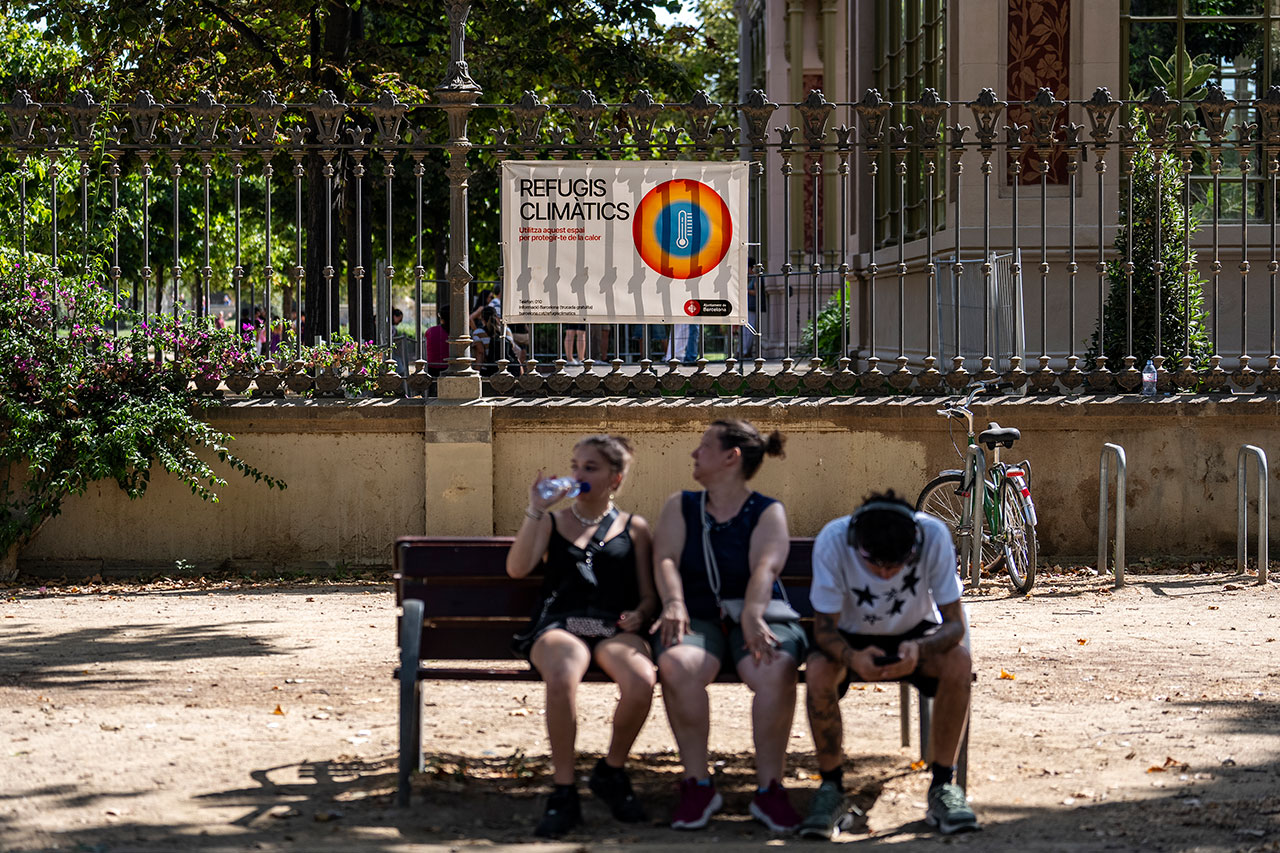
Cities therefore need to provide places where people can escape the heat beyond their own homes. This raises an important question of equity: not everyone has access to air conditioning or lives in a well-insulated home capable of providing protection during prolonged periods of extreme heat. Adaptation strategies need to take these inequalities into account.
This is where Barcelona has taken an innovative approach. Rather than constructing new buildings to protect people from the heat or developing a complex new system, the city looked at what was already there and identified an existing network of public and private buildings and spaces that could take on this additional role.
Libraries, civic centres, markets, museums, schools, parks and school playgrounds can continue performing their usual functions while adding another one: providing protection and thermal comfort during periods of extreme heat. Barcelona has coordinated and communicated this existing climate infrastructure through its Climate Shelters Network.
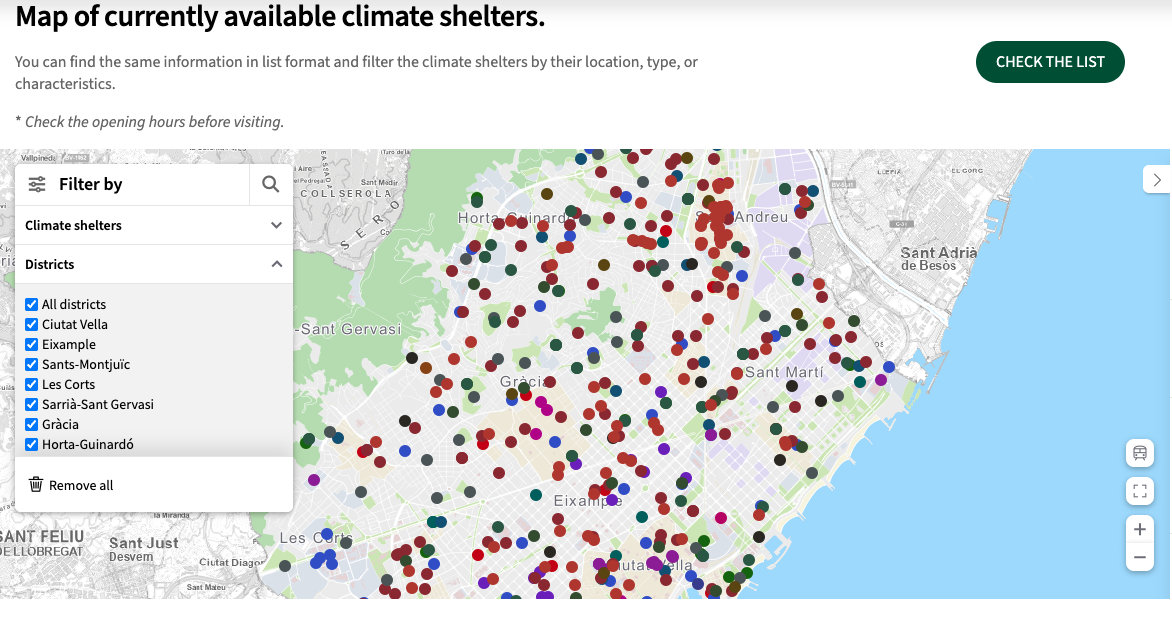
The network has expanded remarkably quickly. From around 70 spaces in 2020, it has grown to more than 500 climate shelters in the summer of 2026, almost 100 more than the previous year. At times of maximum availability, this means that 99.2% of Barcelona’s population has a climate shelter within a ten-minute walk and 76.8% within five minutes.
A network against heat, not a single cooling centre
Vulnerability to extreme heat is not determined solely by age or health. Housing conditions, access to cooling, the surrounding urban environment and people’s ability to move around the city also matter. In this context, distance itself becomes an important climate adaptation variable: a shelter on the other side of the city is of little use to a vulnerable person who has to cross streets at temperatures above 35°C to reach it.
Rather than concentrating its response in a single large cooling centre, Barcelona distributes protection throughout the city. The network includes indoor spaces such as libraries, civic and community centres, museum foyers, shopping centres, and municipal markets, as well as courtyards, play areas and cooler, shaded areas in parks and gardens.
One of the priorities in 2026 has been to strengthen the availability of indoor spaces. Around three quarters of the shelters in the network are indoors, something that becomes particularly important during the most intense heat episodes, when outdoor spaces may no longer provide sufficient thermal comfort.
Not every cool space automatically qualifies as a climate shelter. Spaces in the network need to be accessible and provide seating, resting areas and drinking water. Outdoor shelters need to offer conditions that help reduce heat stress, while indoor spaces have a reference comfort temperature of around 26°C in summer. Access is free, except for municipal swimming pools, which have public prices and financial support available for people in vulnerable situations.
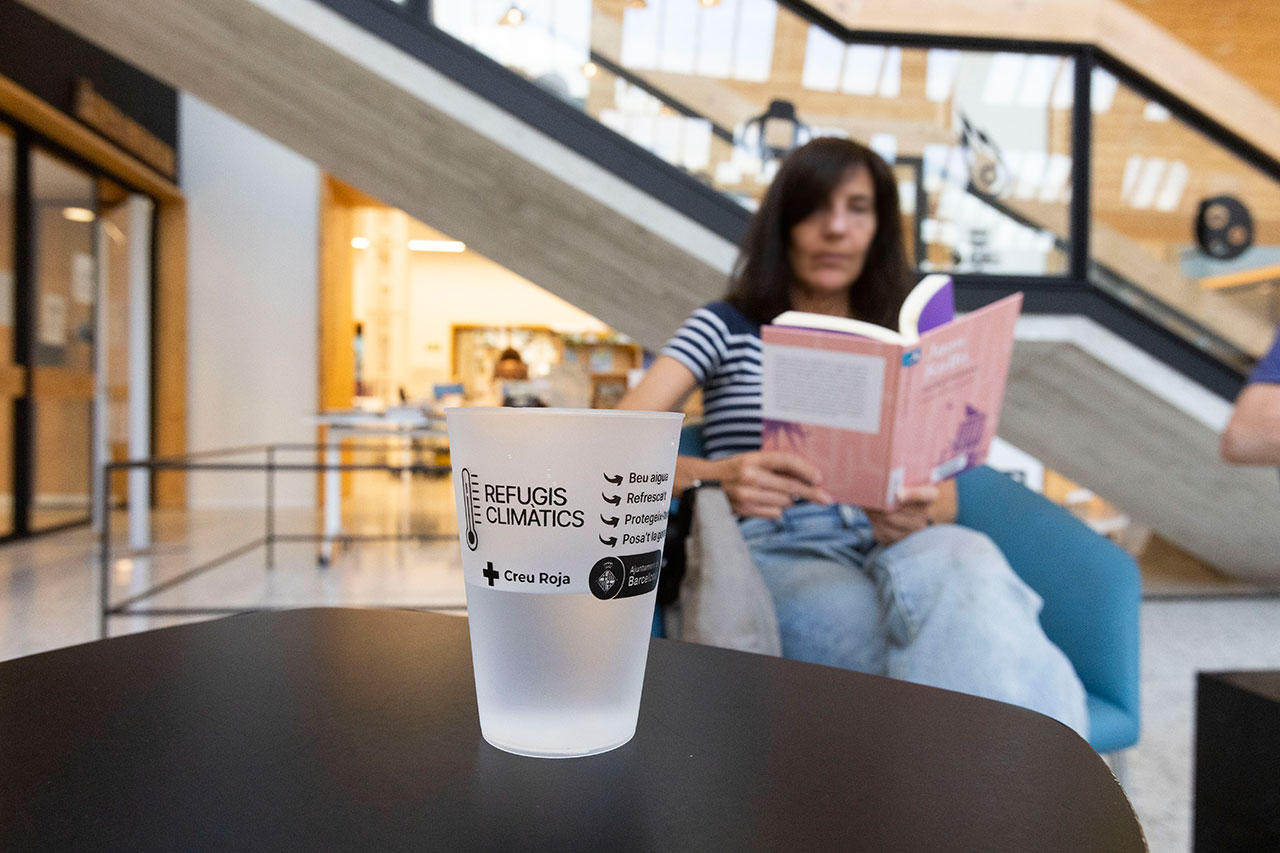
Tomorrow.City has previously explored climate shelters as one of the strategies cities are developing to protect residents during heatwaves. What makes Barcelona particularly interesting is the scale the concept has achieved: it has evolved from around 70 spaces in 2020 to more than 500 just six years later, creating a territorial network based on proximity and embedded in the city’s everyday services.
Availability, however, is not identical throughout the summer. Opening hours affect the actual coverage of the network, and the city identifies Sundays in August as the period with the lowest availability. Even then, 92% of residents still have a climate shelter within a ten-minute walk, and 72% of the available shelters are indoors.
A library does not stop being a library, and a park does not stop being a park. They continue to perform their usual functions while taking on an additional public role that is becoming increasingly necessary: protecting people from extreme heat.
When adaptation also means transforming urban space
The network is not simply about identifying facilities that already offer comfortable temperatures. In some cases, climate adaptation also means physically transforming those spaces.
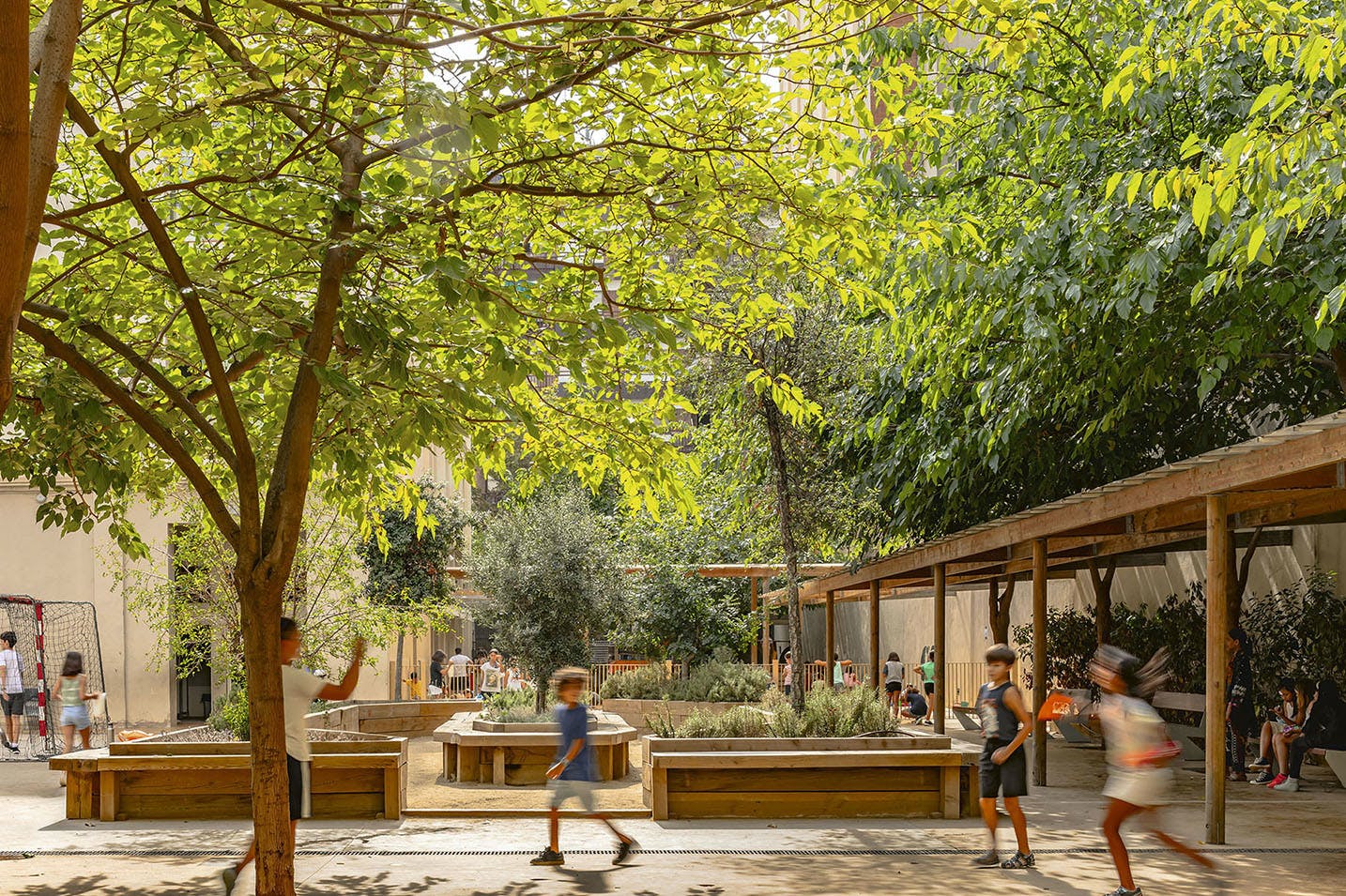
One of the experiences that helped shape the model was the transformation of 11 schools into climate shelters, launched during the 2019–2020 school year as part of the European Urban Innovative Actions programme. School playgrounds, traditionally dominated by hard surfaces, were adapted through a combination of green, blue and grey solutions, including vegetation and trees, new shaded areas and water points, together with interventions in buildings and outdoor spaces.
The project replaced 1,000m² of concrete with planted areas, created 2,213m² of new shade, planted 74 trees and installed 26 new water points. Sensors were also installed in the schools to assess parameters such as temperature, humidity, ventilation, and air quality before and after the interventions.
The result goes beyond providing somewhere to shelter during a heatwave. The same spaces used by pupils throughout the school year become greener, shadier and more comfortable environments and, when opened to the neighbourhood, can also provide protection for the wider community. The pilot project was subsequently integrated into municipal policy through Barcelona’s school playground transformation programme.
This experience illustrates an important characteristic of the network: different levels of intervention can coexist within the same system. Some shelters simply make use of conditions that a facility already provides, others require relatively modest adaptations, while some involve a more substantial transformation of the space.
The concept is continuing to evolve. One of the ways Barcelona is extending the network is through micro climate shelters, small businesses, shops and premises run by local organisations that continue their normal activity while also offering a free and accessible indoor space where people can rest briefly in comfortable thermal conditions.
In 2026, the network has incorporated more than 90 new micro-shelters, including pharmacies, shops and community organisations. Their physical footprint may be small, but their strategic role is significant: they can introduce new points of protection in neighbourhoods where the existing network of public facilities is insufficient and bring climate shelters even closer to residents.
The expansion is therefore not simply about increasing the total number of shelters. The 2026 rollout has prioritised neighbourhoods with greater vulnerability to heat and lower existing coverage, reinforcing the equity dimension at the heart of the model.
Adapting the city with the city we already have
This is perhaps one of the most transferable aspects of Barcelona’s approach. Building climate resilience does not always mean starting with new infrastructure. It can also mean looking differently at the assets a city already has, identifying how they can respond to an emerging risk and connecting them so that they work as a system.
A library already has a building, staff, opening hours and a community of users. A school occupies a strategic position within a neighbourhood. A civic centre is already recognised and used by its community. A park forms part of the city’s network of public spaces. Even a pharmacy or a local shop can provide a few minutes of protection during an episode of extreme heat.
Turning these spaces into nodes of climate infrastructure makes it possible to build on existing capacity and focus resources on adapting the places that need it, coordinating services, signposting shelters, informing residents and, crucially, identifying where the most exposed populations live and which parts of the city still need better coverage.
For other cities, this suggests a particularly useful starting point. Instead of asking what do we need to build?, they can begin by asking what we already have, and how can it protect us better?
For years, the idea of the proximity city has largely been associated with being able to walk to schools, shops, public transport, healthcare facilities or green spaces. Climate change adds another essential service to that list: having a safe place to escape extreme heat within walking distance of home.
Barcelona shows that this protection can be woven into the existing city without necessarily creating a parallel infrastructure. Libraries, schools, markets, parks, civic centres and even small local businesses continue to do what they were originally created to do, while taking on an additional responsibility in a changing climate.
Perhaps this is one of the model’s most relevant lessons: the climate infrastructure of the future does not always have to begin with a new building. Sometimes it begins by recognising, connecting and adapting the spaces we already have.
»Click here for more details about the Barcelona Climate Shelters Network.
»The images in this article were provided by Barcelona City Council.