



Table of Contents
Author | Lucía Burbano
In their goal of improving traffic flow and safety, cities continue to seek and implement mobility solutions. One of the most distinctive is the turbo roundabout, developed in the Netherlands in the 1990s and now adopted by many other countries and cities for its positive impact on urban design.
How is a roundabout different from a turbo roundabout?
In 1996, L.G.H. Fortuijn, a professor in the Department of Transport and Planning at the Faculty of Civil Engineering and Geosciences of Delft University of Technology, had a vision: to improve the standard multi-lane roundabout with a design that would enhance traffic flow and reduce the risk of collisions at these intersections.
The first turbo roundabout was built in the Netherlands in 2000, and its success was such that the country now has nearly 300 of them, along with national guidelines that standardize this innovation in civil engineering and urban planning. In fact, since then, the country no longer allows the construction of simple or multi-lane roundabouts.
The key difference is that, unlike a traditional roundabout, a turbo roundabout requires drivers to choose their entry lane in advance according to the exit they intend to take, as lane dividers prevent last-minute changes. The lanes in turbo roundabouts are designed in a spiral or circular pattern to make traffic safer and smoother, while also improving flow.
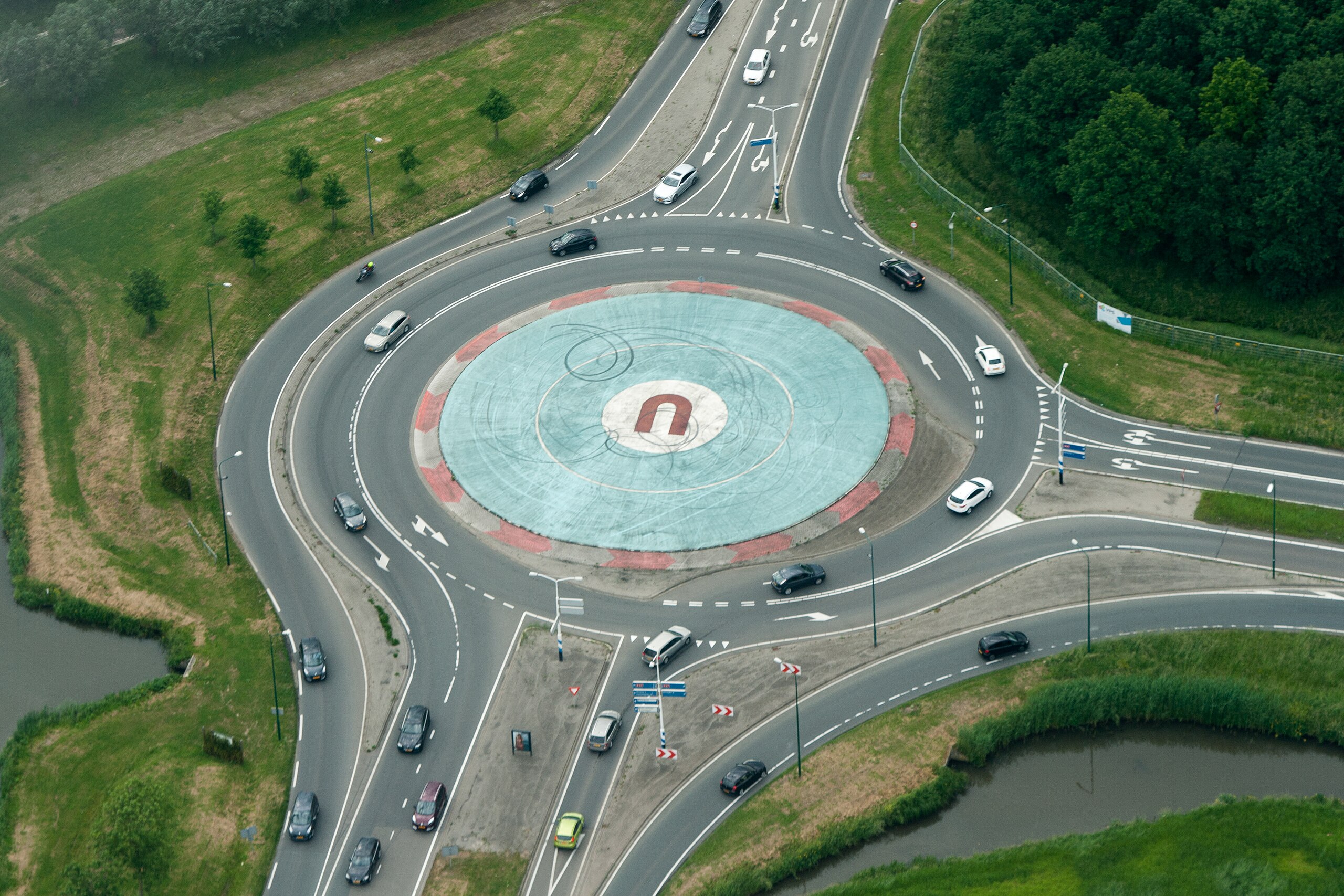
This is a turbo roundabout
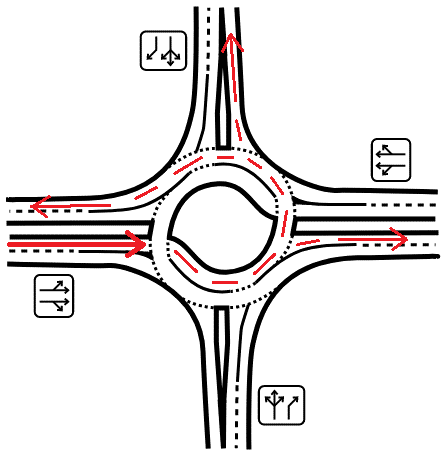
A turbo roundabout is designed with a spiral layout and physically separated lanes, using raised barriers that keep drivers from changing lanes inside the roundabout, guiding them directly to their exit.
This civil engineering project must consider the needs of pedestrians and cyclists, as well as trucks and motorcycles.
Its design includes the following elements, which help reduce speed and increase separation between users, enhancing safety:
- Spiral design that guides traffic in a continuous flow without weaving.
- Radial entry alignment: ensures a steady transition as drivers move from the circulating lane to the spiral path.
- Mountable aprons: widened sections along the inner edge of the central island or at the outer corners of the intersection that provide additional maneuvering space for large vehicles such as trucks and buses.
Advantages of a turbo roundabout vs. a traditional roundabout
In practical terms, turbo roundabouts are more straightforward than traditional ones, as they demand fewer choices from drivers, improving traffic flow and boosting the number of vehicles that can move through.
That said, drivers must pay attention to signage before entering a turbo roundabout to position themselves in the correct lane and ensure they can take the proper exit.
Turbo roundabouts also stand out for other reasons.
They offer greater flow
A quick assessment model indicates that the capacity of a turbo roundabout is 25% to 35% higher than that of a standard two-lane roundabout. This is thanks to its guided lanes, which prevent lane changes and make the roundabout more efficient by reducing conflict points and eliminating interior yield signs, allowing for a more consistent speed.
They reduce fatal accidents
From their early implementation, between the late 1990s and 2015, turbo roundabouts proved to be life-saving, reducing fatal accidents by at least 50%.
They also reduce accidents and traffic incidents
Studies and experiments show that traffic accidents are reduced by 72% in turbo roundabouts compared to traditional multi-lane roundabouts.
They produce fewer emissions
According to a study conducted in the Czech Republic, CO2 emissions from vehicles in conventional roundabouts are up to 53.62% higher than in turbo roundabouts, making them important allies in decarbonization efforts, particularly in cities expanding their periphery.
Images | Jeroen Komen (CC BY-SA 2.0), Tarquinius89 (CC BY-SA 4.0)