



Table of Contents
This article was originally published by the World Resources Institute Ross Center for Sustainable Cities. It has been updated and republished here with permission. Written by Anusrita Kundu, Manojna Polisetty, and Sharvari Patki.
Electric two-wheelers and electric cars increasingly appear on Indian roads, but road freight continues to run almost entirely on diesel. Electrification of trucks requires a large-scale charging backbone that does not yet exist.
E-Trucks carry heavy loads over long distances; therefore, their charging needs are different than those of cars. E-truck charging stations require high-capacity grid connections, larger sites and carefully planned electrical systems.
What Makes e-Truck Charging Different?
Charging an e-truck is not as simple as plugging it into a wall socket. A charger at a highway charging station draws high power — imagine simultaneously running almost 130 household air conditioners.
Unlike passenger EVs, which typically use smaller batteries of 30-60kW, e-trucks rely on large battery packs that often exceed 200 kWh. They also need high-power charging to keep downtime to a minimum. Several Electric Vehicle Supply Equipment (EVSE) manufacturers in India are already making high-power (360-400 kW) DC fast chargers.

Keeping pace with these developments, the public charging guidelines under the PM e-Drive scheme also recommend DC fast chargers with Combined Charging System (CCS2) gun for plug-in charging and a minimum power output of 120kW.
Supporting this level of capacity requires dedicated electrical connections beyond what a typical passenger EV charging station offers. Additionally, these charging stations require sufficient space for multiple large vehicles to manoeuvre safely and operate round the clock.
This kind of infrastructure requires strategic investments. Charging networks can be first deployed along major logistics hubs and freight-heavy corridors where demand is highest and gradually scaled up. This phased approach can help spread investments over time while aligning with India’s Viksit Bharat Net Zero 2047 vision.
Where Does Power Come From?
Beyond physical infrastructure, charging stations also require access to reliable electricity. Electricity supply has three stages: Generation (from thermal or renewable energy plants), transmission and distribution.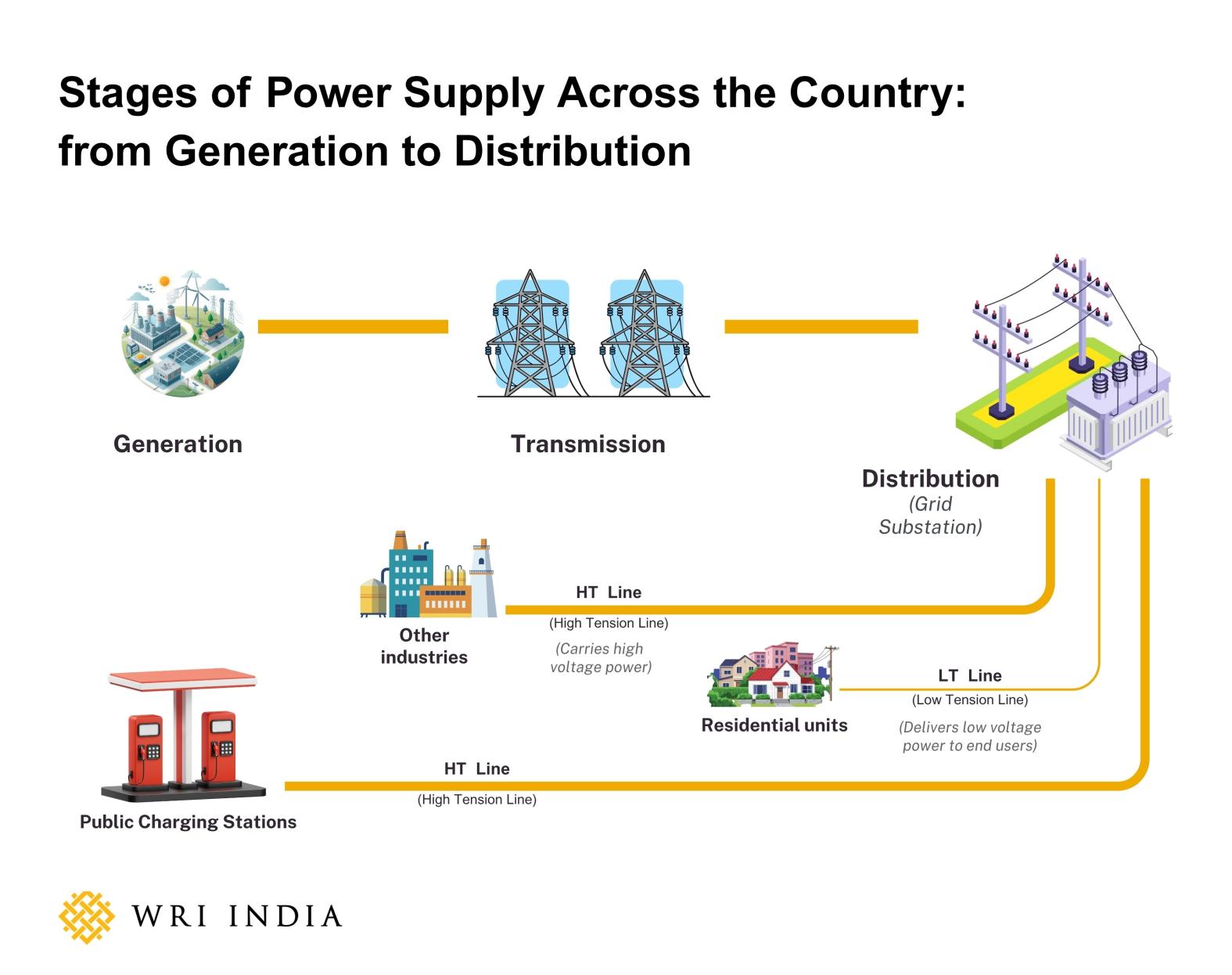
Stages of power supply from generation to distribution. Graphic by Anusrita Kundu/WRI India.
India generated about 1,530 billion units (BU) of electricity in FY 2024-25. About 16% of this was from renewable sources. The generated electricity travels across the country through high-voltage transmission lines, held up by the tall electric towers often seen along highways. Under the current National Electricity Plan, this transmission network is projected to expand by nearly 30% by 2032. This expansion planning can handle generation and transmission capabilities including the projected 50% RE by 2030. The final stage is distribution — the local networks that delivers electricity from substations to end users. These are typically built around existing demand with some future provision.
To put charging demand in perspective: national level assessments estimate that electrifying India’s truck fleet by 2030 would require around 9GW of charging capacity. That is approximately 1.8% of the country’s current ~ 500 GW installed capacity. This suggests that upcoming e-truck charging requirements can be accommodated.
Furthermore, business models that support renewable-powered freight operations are gaining traction. For instance, logistics operator TransVolt Mobility has signed a solar power agreement with Ravindra Energy, to source electricity for their e-truck operations. Such arrangements can help electric fleets access RE while complementing the broader grid supply.
New facilities such as highway charging stations thus require careful planning and targeted upgrades. This is why freight-intensive corridors must be prioritised, with gradual expansion as demand grows.
Anatomy of a Highway Charging Station
Regardless of the technology used to charge e-trucks, the power drawn to the charging station is substantial. Managing this high load safely requires dedicated electrical infrastructure before electricity can reach the chargers and the truck.
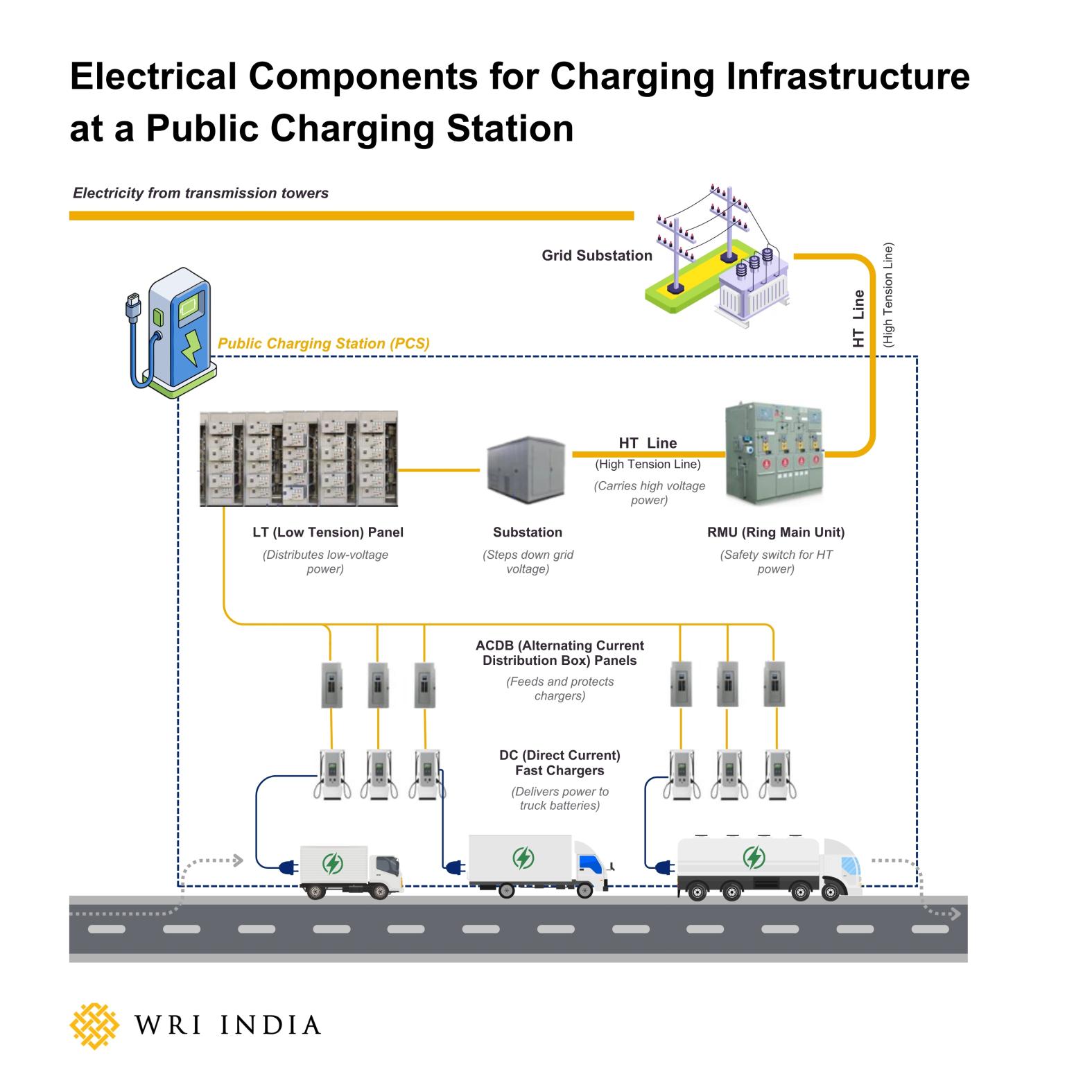
The charging facility draws electricity from a grid substation through a dedicated high tension (HT) line, typically used for facilities with large electricity demands.
It then flows through a layered setup to safely step down the large power load and enable reliable and high-power charging. Key components such as ring main unit (RMU), on-site substation, low tension (LT) panels, etc., step down voltage in stages and ensure stable and safe power distribution to individual fast chargers, responsible for charging e-trucks. Additionally, smart energy management systems are added to help optimise power across multiple charging guns during peak usage.
The Road Ahead: Financial Feasibility Analysis
Setting up a highway charging station requires capital investment in upstream infrastructure upgradation. Once operational, the station continues to draw a large amount of electricity as multiple trucks charge throughout the day.
These costs add up and determine charging tariffs, ultimately affecting the feasibility of operating an e-truck. Striking the right balance between infrastructure investment and affordable operations is essential for scaling e-trucks sustainably.
Photos: WRI, Rishu Bhosale