



Table of Contents
Author | Lucía Burbano
Sustainable mobility cannot be achieved without innovative technologies and business models that help address one of cities’ biggest challenges: managing road traffic. In this context, Mobility as a Service (MaaS), emerges as a solution that enables the seamless integration of multiple transportation modes, improving traffic flow and reducing emissions.
What is Mobility as a Service (MaaS)?
MaaS, short for Mobility as a Service, is an ecosystem that brings together a city’s sustainable mobility providers, from traditional public transportation to shared options such as bicycles, scooters, motorcycles, cars, or on-demand transport services, allowing users to compare and book the most suitable option in real time through a single app.
Definition and scope: beyond apps, tickets and modes
In the field of urban mobility, the main goal of MaaS is to promote sustainable transportation and show how new business models can reduce the need for private vehicles, improving traffic flow, encouraging multimodality, and leveraging information technologies.
Why MaaS transforms urban mobility and user experience
For cities, Mobility as a Service is key to:
- Reducing traffic congestion, by encouraging the use of shared and public transportation.
- And as a result of this, reducing carbon emissions in urban areas.
- Improving transportation efficiency, as the data generated by MaaS apps can help manage transport infrastructure more effectively.
- Boosting the local economy by creating jobs in related sectors.
For users, MaaS offers:
- Convenience and ease of use, as trip planning and ticket booking are managed through a single platform.
- Access to multiple transportation options.
- Savings on transportation costs, allowing users to choose the most economical mode for each trip.
Multimodal integration, journey planning and real-time information

These three elements are the pillars of Mobility as a Service:
Multimodal integration
The combination of public transportation, shared mobility, parking, and micromobility to reduce reliance on private cars.
Trip planning
Allows users to compare and combine routes based on factors such as time, cost, emissions, or convenience.
Real-time information
Provides up-to-the-minute service status, including delays, incidents, vehicle availability, occupancy, dynamic alternatives, and estimated travel times.
Payments, subscriptions and mobility wallets
Integrated or seamless payments allow a single payment for multimodal trips, even when multiple operators are involved. There are three models: pay-as-you-go, postpaid, and prepaid.
MaaS subscriptions are recurring payments that provide access to a bundle of mobility services, replacing individual tickets.
E-wallets, in the MaaS context, are centralized digital balances used to pay for all mobility services.
Data platforms, APIs, and interoperability
These elements of the MaaS architecture are essential for several reasons:
Data platforms in MaaS collect, combine, and distribute data from different operators and payment systems. They manage both static data, such as routes or fares, and dynamic data, such as traffic conditions or weather.
Application Programming Interfaces (APIs) serve as the common language for all the systems involved, while interoperability refers to the ability of these different systems to integrate smoothly.
Governance, accessibility and safety-by-design
Governance defines who makes decisions, who controls the system, and under what rules the MaaS ecosystem operates. Accessibility goes beyond accommodating people with disabilities, focusing on improving the system universally for all users. Finally, security protects both user and infrastructure data.
Tomorrow.City’s Unique Approach
Connecting stakeholders and showcasing MaaS technologies
With a global reach that connects cities, industry, and technology providers across continents through its various digital content divisions and events such as conferences, exhibitions, and networking, Tomorrow.City is a benchmark for cities that embrace both challenges and opportunities.
In the field of sustainable mobility, this global network also connects stakeholders and showcases leading examples related to MaaS.
How to choose a MaaS provider or partner

Essential criteria: scalability, interoperability, security and UX
These are the essential criteria:
- Scalability: A MaaS platform must be able to grow in users, services, operators, and coverage area without requiring constant redesigns.
- Interoperability: Determines whether the platform can integrate into a diverse and evolving mobility ecosystem.
- Security and privacy by design: MaaS platforms manage highly sensitive data. Therefore, security must be built into the architecture from the start.
Common mistakes to avoid in MaaS projects
Treating mobility as a simple app when it is actually a complex system. Likewise, relying too heavily on a single provider limits the system’s future flexibility and makes it harder to incorporate new services or operators.
Integration with public transportation must also be carefully managed; otherwise, the platform risks becoming merely an aggregator of private services.
The Future of MaaS
Autonomous Vehicles (AVs)
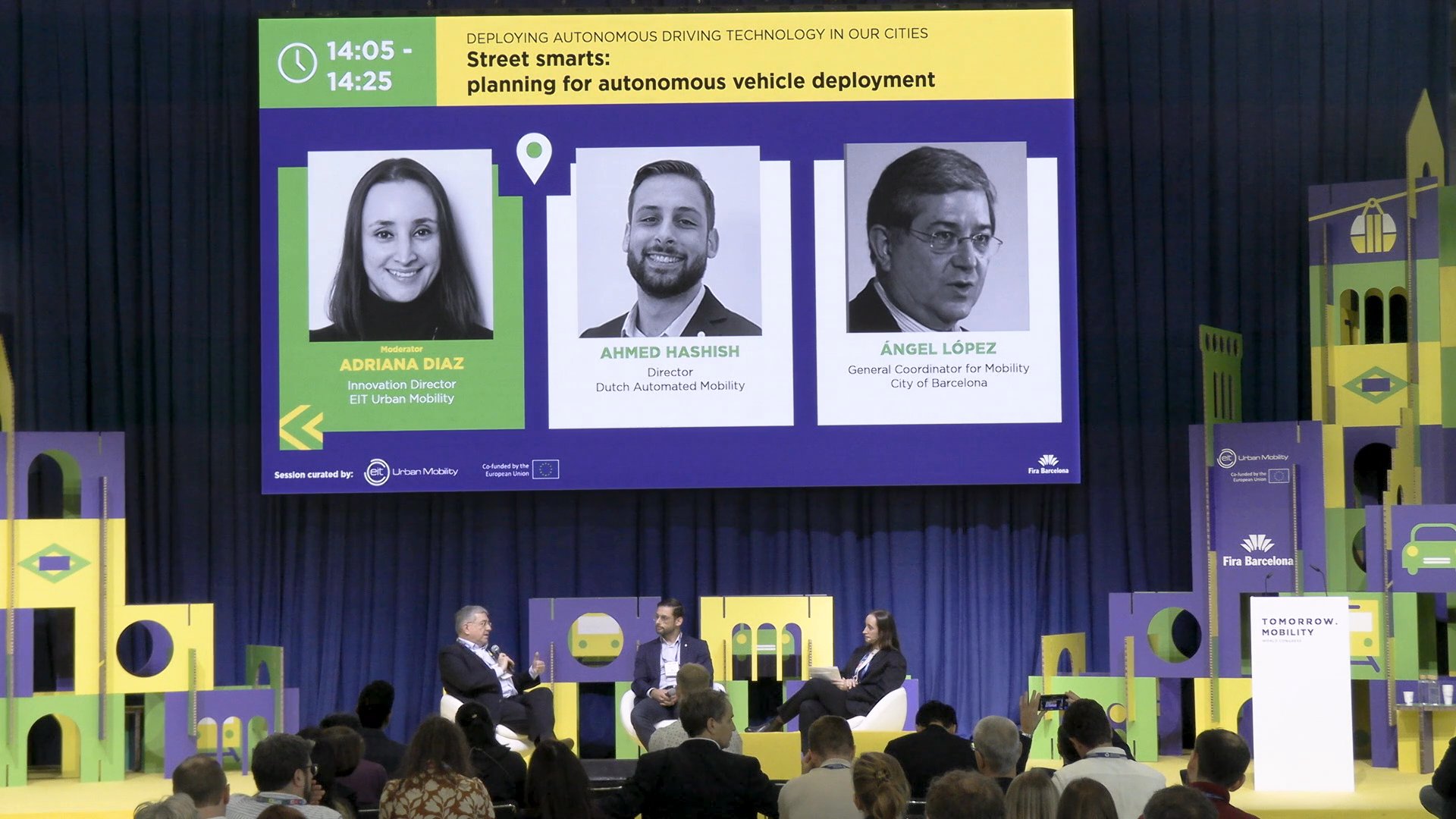
Autonomous vehicles will transform MaaS by introducing new service models, particularly for first- and last-mile connections.
On-Demand Mobility
A key pillar of modern MaaS, it is dynamic and allows for the consolidation of trips.
Micromobility
Established as an essential component of urban MaaS.
How Tomorrow.City connects global players shaping MaaS
Tomorrow.City serves as a platform for connection and knowledge among the stakeholders driving MaaS evolution worldwide, anticipating emerging trends and challenges that accelerate the adoption of sustainable and scalable MaaS models.
Photographs | Unsplash/Julio Lopez, Unsplash/ ran liwen, Unsplash/Honbike