



Table of Contents
Author | Jaime Ramos
One of the biggest challenges of electric mobility today lies in achieving sustainable and renewable energy production to power the revolution. What role does solar power have to play in this process?
The issue, in this regard, lies in breaking the well-to-wheel method in order to move on to another wind or solar panel to wheel method. Because, although fully electric cars do not have tailpipe emissions, this does not mean there is not a carbon footprint associated with the production of the vehicles and the generation of the electricity that powers them.
According to the International Energy Agency (IEA), well emissions account for an average of 202 grams of CO2 per kilometer for fuel combustion models; while that figure is reduced to 83 grams for pure electric vehicles. Although there has been undeniable progress, we are reaching the point when progress can only be made with renewable energies.
Solar power and electric cars: a complex relationship

From the start of the last and definitive transition towards electric cars, the use of solar power has become an ambitious goal. There have been a series of solar solutions in recent years which, in general, have not been sufficiently successful to be applied on a massive scale.
Solar panels in electric cars
They may seem promising, but they still lack the necessary functionality. Countless universities and manufacturers have embarked on projects to integrate photovoltaic cells in cars.
However, the cost-efficiency ratio is, still today, an insurmountable obstacle. Among the manufacturers still seeking this objective are Toyota which, in 2019 installed panels in its famous Prius Plug-in promising a driving range of up to 56 kilometers. The Japanese are still insisting on this idea, with new technologies indicating a power conversion efficiency of 26.81%.
Solar roads
As illustrated, any surface exposed to sunlight can be converted into a source of energy production. We have seen this with solar windows and, in terms of smart roads, solar roads sometimes emerge as a promising solution, however, not without issues, such as implausibly high costs for the small quantities of energy they produce.
Solar charging stations, what are they?
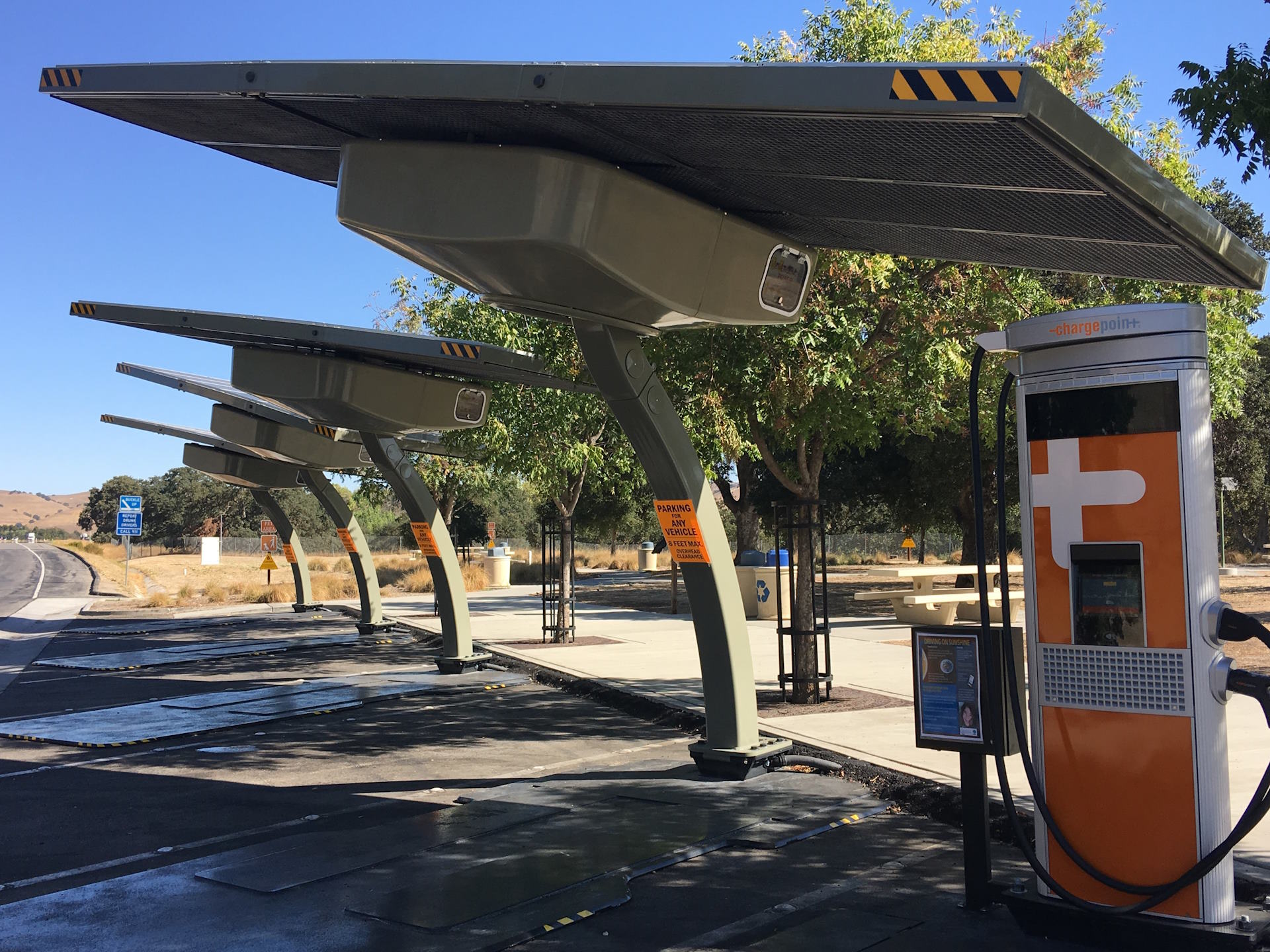
Solar charging stations, luckily, appear to be a technology that can provide advantages for photovoltaic generation for road traffic. These are stations that provide electricity for vehicles, with the particular feature that they have the capacity to generate their own power and store it. Thanks to the use of solar panels, they comply with the essential requirement to provide 100% renewable energy.
Advantages of solar charging stations for cities

The strong points of these facilities include:
- A fruitful and smart relationship with the power grid. They can send surplus power back to the grid to alleviate the strain but also claim power if needed. This provision of power is even more valuable in cities, where the energy demand is much greater.
- The integration of solar panels is simple and they can be used via different designs and surfaces. This is ideal in urban spaces in terms of making use of existing structures or buildings; adapting to them efficiently; and also offering a very conciliatory solution in terms of architectural aesthetics.
- As they fall within the dynamics of city sustainability, they are also included in the flow of information, which helps to improve town-planning. They enable authorities to measure the efficiency of their use, through the interpretation of their contribution to both the power grid and to drivers. This makes it easier to address situations of greater energy demand; or to determine traffic patterns in order to know how much power the vehicle fleet needs and/or where charging points are required.
And there is another fundamental issue: The efficiency of photovoltaic panels has reached historic levels. During this decade, panels are available that exceed a conversion efficiency of 20%. The trend is on the rise and, today, there are already projects that have achieved efficiencies in excess of 47%.
Examples that show that solar charging can reach even greater heights

These theoretical advantages that are still to be explored will accelerate the introduction of the solution. Its simplicity means it can be implemented quickly, even at a local level.
For example, in Peachtree Corners, within the metropolitan area of Atlanta, they have incorporated solar charging stations. The authorities are aware of the pressing need to provide charging solutions for an increasing number of electric vehicles. In addition to this, there are numerous examples in various parts of the United States, including on San Diego, that have public fleets powered by solar energy.
In other parts of the world, such as India, the momentum has even reached state planning levels. In 2021, it was established that all public charging stations had to incorporate solar panels in order to cover at least 10% of the installation capacity. This has boosted the private initiative to incorporate solar proposals. In 2022, the company ATOM Charge installed up to 250 solar charging stations in the country.
Domestic solar charging stations
The massification of solar power does not only involve the public and private sector. The domestic arena is also experiencing a similar phenomenon. There are an increasing number of companies offering joint solar panel and charging point installations, taking advantage of this trend.
Unsurprisingly, electric vehicles are acting as a stimulus, with many drivers showing an interest in this "energy independence" at a domestic level, which also takes some pressure off urban grids. According to the independent portal Solar Reviews, the US solar industry may recover an investment of around $5 billion in just over two years.
Images | Wikimedia.commons/Mavila97, Toyota, BMW and Hyundai