



Table of Contents
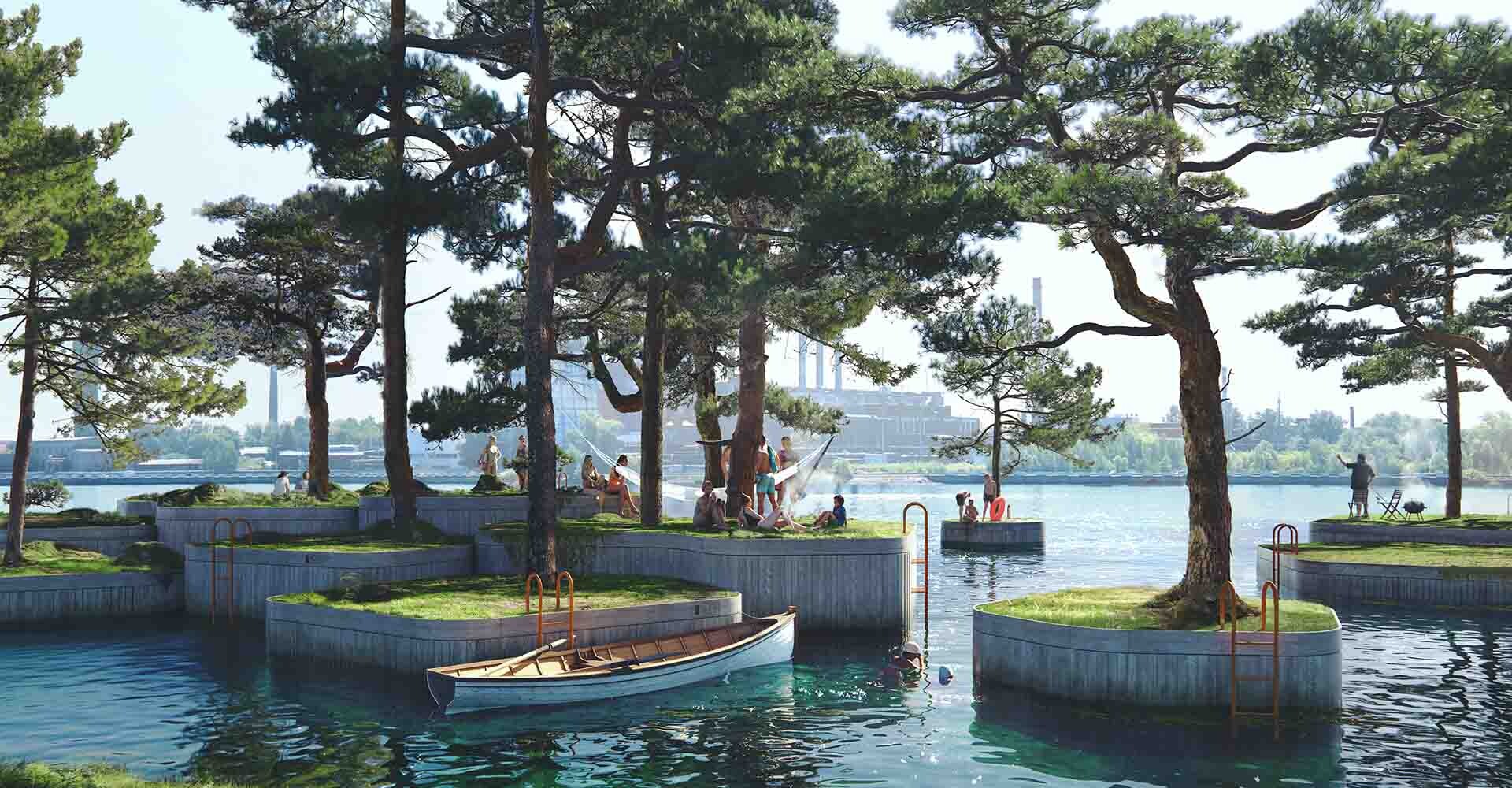
Author | Tania Alonso For decades, coastal cities around the world have gained land by taking it from the sea. Today, with the looming threat of climate change, some of these cities are turning to more environmentally-friendly urban planning solutions.One of these is the Copenhagen Islands, a project that seeks to introduce parks and public spaces into the city in the form of floating islands. These can move from one area to another, depending on the city’s requirements, and even join together to form a large area that can be used for major events.
A new public space
Denmark is a country in which the sea plays such an important role that the word island is one of the easiest to learn in the language: “ø”. Part of its capital, Copenhagen, is built on islands, which communicate via bridges that cross its canals.Now, a project approved by the city hall and designed by the Australian architect Marshall Blecher and the Danish designer Magus Maarbjerg, from the Studio Fokstrot, seeks to introduce a new form of public space in the city, also on islands, but this time artificial islands. The aim is to give the city’s industrial port area a new lease of life, which has seen considerable development in recent years.Another reason is to create leisure areas for citizens to enjoy, that can be adapted to rising sea levels, one of the challenges facing Denmark in the coming years. The project also aims to create a new resilient urban planning approach, based on recycled and sustainably sourced materials. Each one of the islands is being built by hand in the shipyard of Copenhagen’s port, using traditional wooden boat building techniques.
Copenhagen Islands: a “parkipelago”
The first of the floating wooden islands, which is called CPH- Ø1, covers an area of just 20 square meters and has a tree in its center. It was installed in the port in the north of the city in 2018, and has been moved to various different points since then.The idea is for this to be the first of many, and for a series of islands to be installed along the city’s coast, forming a “parkipelago”. CPH- Ø2 and CPH- Ø3 were prepared to be installed in March 2020, however, the pandemic meant the inauguration has had to be postponed until Spring of 2021.To date, CPH- Ø1 has hosted a photography exhibition, a series of lectures and many visits by citizens, who now use it as another part of the city. Once the rest are installed, they will be able to be joined together to form a super continent and be used to host various activities, such as concerts or exhibitions. Although these are just some of the potential uses.
A long list of possibilities
According to their creators, the floating islands can be used as a base for swimmers, as spaces to open a bar, a cafe or a sauna or even as mussel farms. The plans for Copenhagen Islands also include the creation of parks, gardens or urban vegetable gardens, which would provide more space for endemic plants, birds, insects, algae and mollusks.This is yet another alternative for Copenhagen, a city that is already looking to its sea and its canals and offers a wide variety of leisure options on the coast. Except that this time, the public spaces will be able to be moved anywhere they are required. Images | Marshall Blecher, Magnus Maarbjerg