



Author | Lucía Burbano
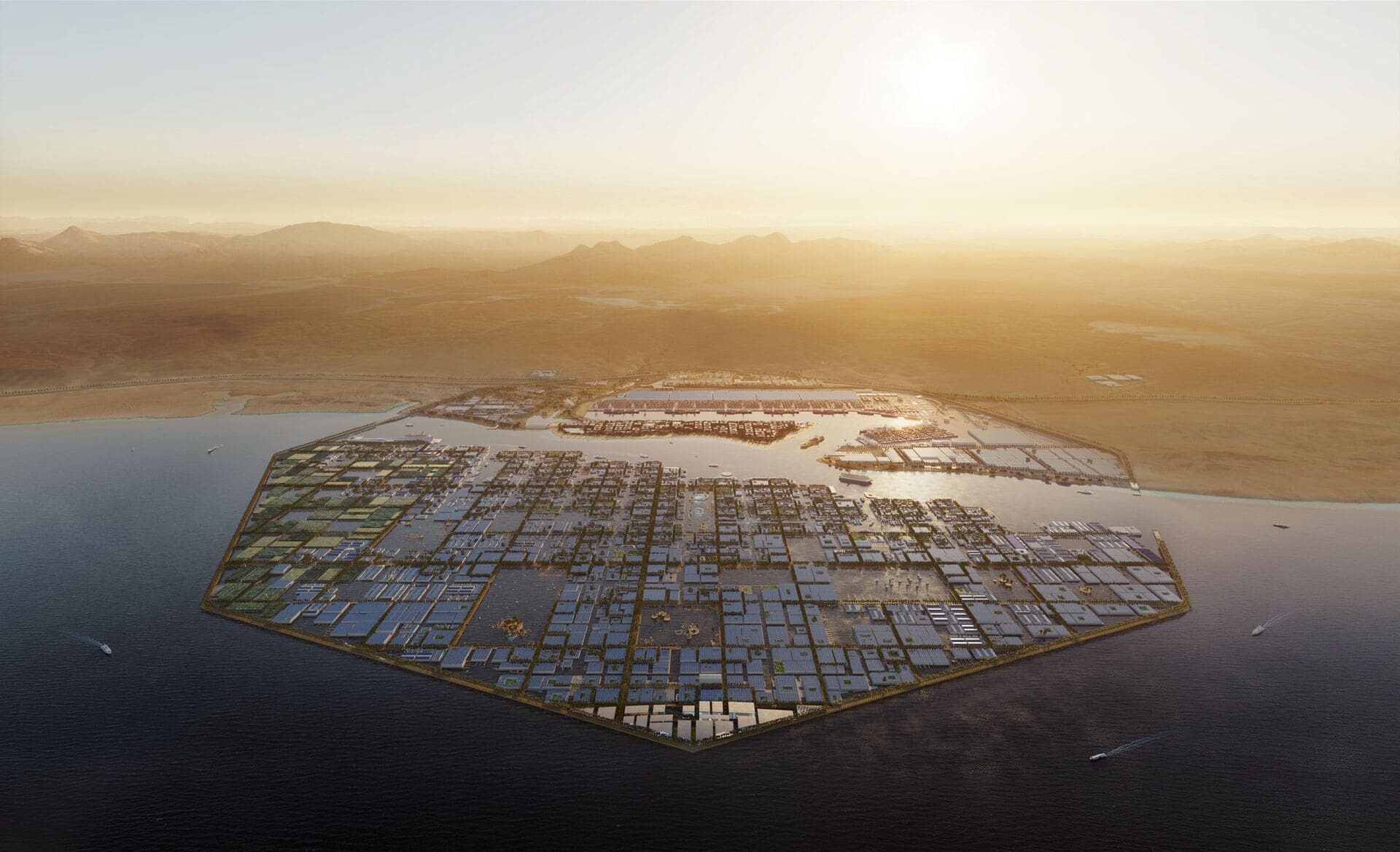
The infrastructures of the smart city NEOM, in Saudi Arabia, are taking shape. Located in one of the most water-scarce regions in the world, NEOM has plans for a sustainable and innovative water management system with the construction of a green hydrogen desalination plant.
NEOM’s ambitious plant to supply the entire region with water
"Change the future of water", that is how NEOM announces its plans to supply the nine million residents that will live in the Saudi Arabian smart city.
NEOM has a specific plan to achieve this: build a state-of-the-art desalination plant with 100% renewable energy obtained from green hydrogen, which will start to produce water by 2024. Located in the industrial zone of Oxagon and built by ENOWA, NEOM’s water and electricity subsidiary, in collaboration with ITOCHU and Veolia, it will function with a high-recovery reverse osmosis system.
The desalination plant with a 500,000 m3 per day capacity, will meet approximately 30 percent of NEOM’s forecasted total water demand. The production capacity of the desalination plant in NEOM will be 2,000 megawatts, which is ten times the largest planned production facility in Europe.
Gavin van Tonder, Executive Director of Water at NEOM, explains that NEOM’S water will be 100 per cent desalinated using renewable energy to ensure zero CO2 emissions as well as zero brine effluent discharge to the sea.
"The entire cycle will be the first of its kind in the world as the process is based on a circular economy model. It will also be the first time in the world that mineralized water is supplied that is the same quality as spring water to facilities and homes, with the aim of eliminating the need for bottled water."
The Arabian Peninsula, a region where water is scarce
The Arabian Peninsula is one of the most water-scarce regions in the world, with limited fresh water sources and high levels of water demand. Also known as Arabia, it is the largest peninsula in the world. With 3,237,500 square kilometers distributed across seven countries, it has over 77.9 million inhabitants.
The lack of water in the region is due mainly to natural factors, including limited rainfall and high temperatures, but also human activities such as overexploitation of underground water resources and inefficient irrigation practices.
Saudi Arabia is characterized by a desert climate with average annual rainfall in most of the country below 150 mm throughout the entire year, except in the southwestern part of the country, where average annual rainfall ranges between 400 and 600 mm. It is the tenth most water-stressed country in the world.
How will the NEOM desalination plant work
A desalination plant separates salt from seawater to convert it into water suitable for human consumption and industrial and irrigation uses through two types of processes: thermal or membrane systems.
In the first process, saline water is heated to produce water vapor, which is then condensed to produce freshwater. The second, and the one that will be used in NEOM, transfers water through semi-permeable membranes, which allows the salt to be separated from the water. It will use reverse osmosis, which applies mechanical pressure, to counteract the natural osmotic pressure to filter the water to obtain a lower concentration of salts.
NEOM’s desalination plant will also use advanced and innovative technologies to obtain concentrated flows of brine to convert the salt into a product and no longer waste. This will minimize the plant’s environmental impact and redefine the business model of future desalination plants.
Brine generated from the desalination plant will be treated by ENOWA to feed industries utilizing high purity industrial salt, bromine, boron, potassium, gypsum, magnesium and rare metals as raw materials.
It will also incorporate a smart network that will include water flow, water volume, temperature, water quality and pressure management zones.
Photos | NEOM