



Table of Contents
Authors | M. Martínez Euklidiadas, Raquel C. Pico
Can architecture socially destabilize an entire neighborhood? Does the shape of buildings play a role in the presence of organized crime? The Sails of Scampia (Vele di Scampia, in Italian) are proof that architecture influences the behavior of citizens, or at least, that it can be used for unlawful purposes quite successfully.
During the 80s, the Camorra criminal organization managed to establish itself in the Sails of Scampia, at the time a newly created neighborhood in Naples. Thus, an architectural project that had been created to improve urban public housing conditions and also include vulnerable groups, instead became a source of problems, a crime hotspot and an environment that made its residents even more vulnerable. Now, half a century after construction began, the Sails of Scampia remain as a brutalist reminder, giving way to a process of urban regeneration.
The case of the Sails of Scampia
By 1960, Naples was facing a serious poverty problem. Located in southern Italy, the area had been economically depressed throughout much of the 20th and 21st centuries. Despite its enormous artistic heritage, economic hardships were a daily reality, and its residents lived in poor conditions.
Naples needed an urgent urban planning reform. One of the potential solutions was to build in a new area in the 1960s: Scampia was going to be one of the city’s commuter neighborhoods, where people in need of housing would be relocated. It was a solution adopted by many other European cities during the 20th century to meet the needs of their vulnerable communities.
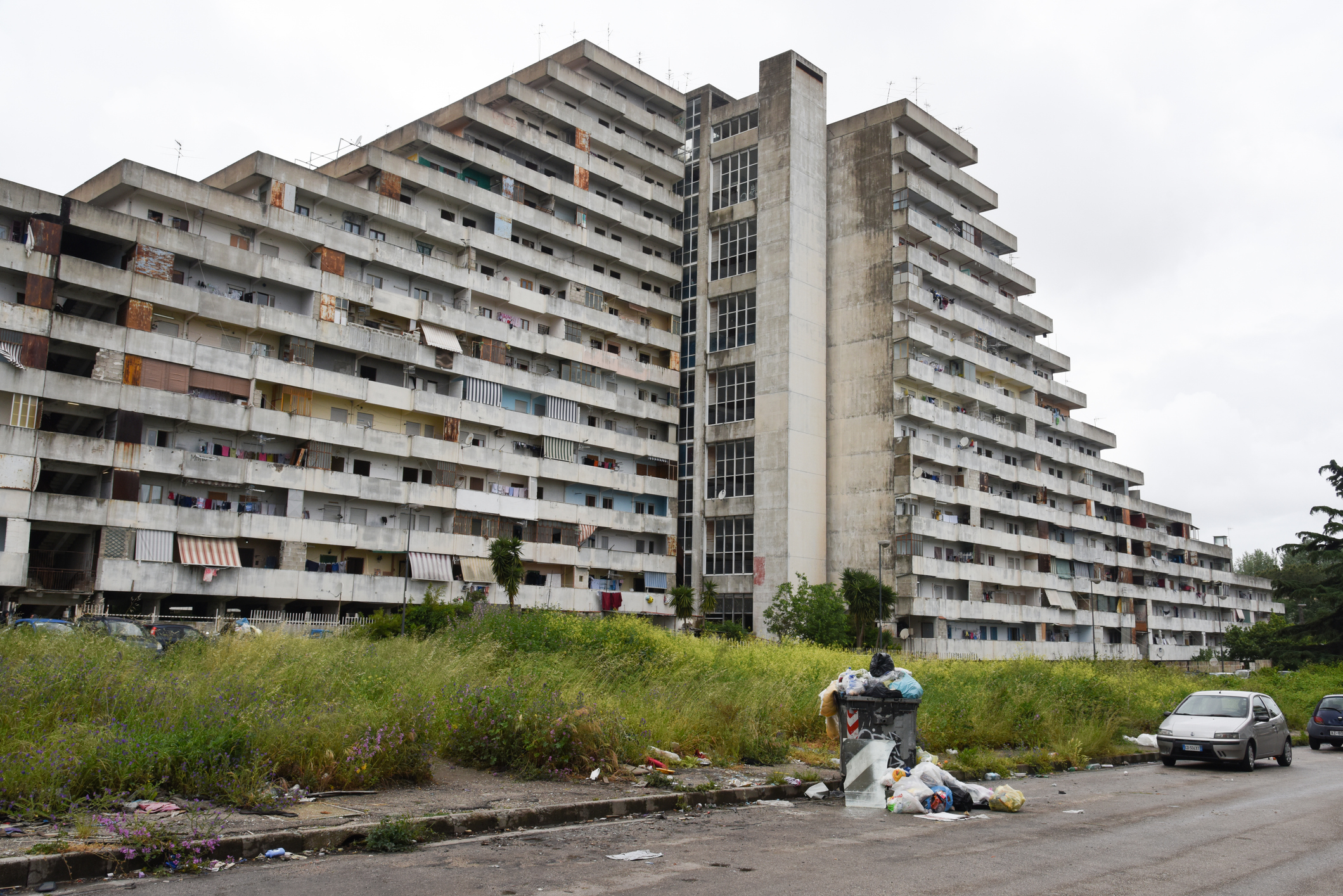
But, to achieve that goal, buildings were needed. That is when the Sails of Scampia housing project emerged, designed by the architect and urban planning expert, Franz Di Salvo. Based on new state laws, Di Salvo designed a truly modern housing complex. Brutalism, latest trends, and urban development came together to offer a housing solution for the city’s vulnerable communities.
From 1963 to 1975, the years in which the Sails were built, the project seemed to be going well. Hundreds of homeless families were relocated in these buildings, officially named with different letters of the alphabet but which eventually became known by their colors (Yellow Sail, Blue Sail…). A public housing complex was created.
The project was portrayed internationally as a success, but behind the social urban planning and good intentions, corruption was rife. The structure was based on an illusion made up of bribery. The foundations were not solid and organized crime took advantage of every crack. What could have been another brutalist icon instead became a failed development.
The influences of Le Corbusier and Kenzo Tange in Scampia
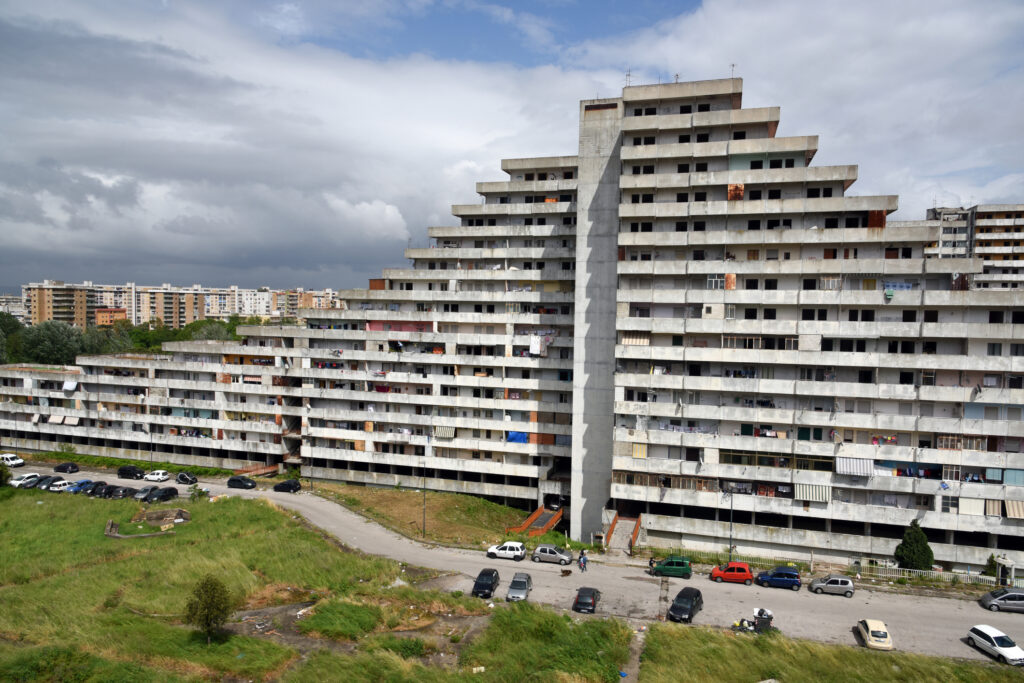
In architectural terms, The Sails of Scampia did not just appear on a canvas. To design them, the architect Franz Di Salvo drew inspiration from other earlier state subsidized housing buildings, both French (such as the work of Le Corbusier) and Japanese (such as that of Kenzō Tange). In fact, the triangular structure is based on the former, while the internal walkways which, incidentally, also provided hiding places for the Camorra, to the latter. Di Salvo drew on top-level references and was ambitious in setting goals for the spaces, which, in his philosophy, aimed to have a positive impact on both residents and the city.
It is interesting that buildings designed with social centers, areas for children to play, a giant park, community facilities of all sorts and even a public train station, can deteriorate to such an extent that they become magnets for criminal activities.
Today we know that this architectural model is not functional, particularly not for public housing. Higher urban density has proven to be extremely useful in terms of generating value by uniting talent. However, this works at a city level, in a broader context. When applied to neighborhoods where at-risk populations are concentrated, it ends up creating ghettos. Urban planning ends up becoming another barrier, and density a social cost.
Why did this urban development project fail?
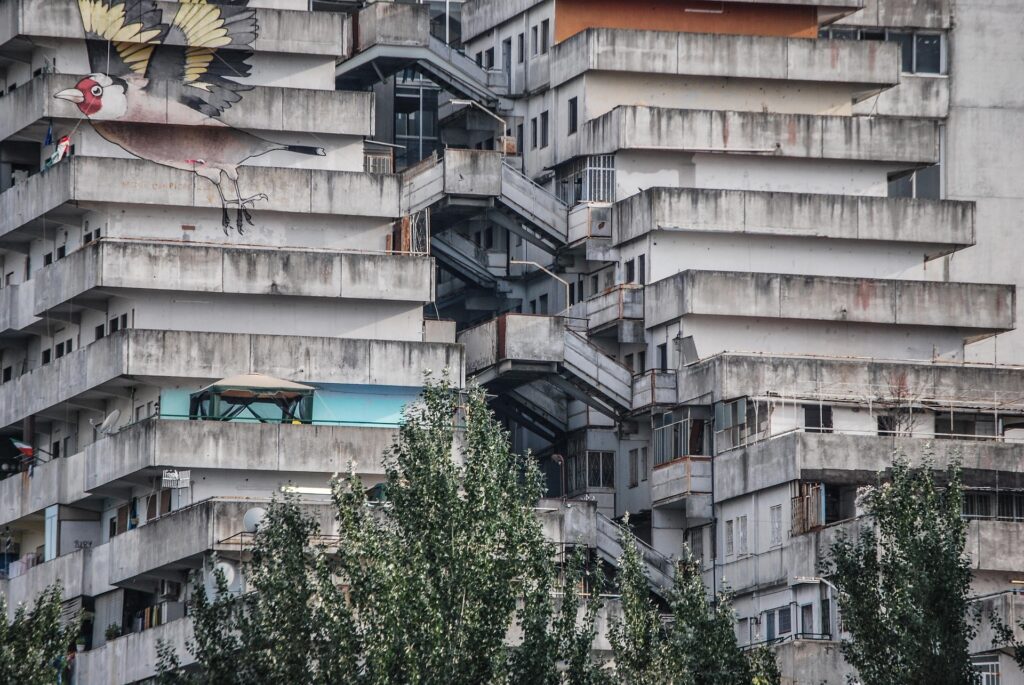
No urban planning failure is the result of just a single factor, and the Sails of Scampia are no exception. Numerous circumstances converged (government, urban planning, design and social circumstances), which converted the area into a ticking time bomb.
A poor application of law 167
In 1962, a few years before the buildings were constructed, an urban planning reform was approved in Italy by Fiorentino Sullo. Law 167 was set to become one of the best urban planning policies in terms of social integration, however, exactly the opposite occurred.
Today we understand why, but back then it was not so obvious. Instead of constructing new buildings and combining people in them from different educational backgrounds, different income ranges or nationalities, the Naples city council concentrated thousands of low-income, poor or extremely poor families in these buildings. These subsidized housing projects became a breeding ground for crime.
Misappropriation and occupation after the earthquake
Although the buildings were initially designed for around 40,000 people, even before they were completed they already housed around 90,000 inhabitants, almost a tenth of Naples. This was due to various factors. Firstly, the misappropriation of public funds, which prevented the buildings from being completed. Secondly, the 1980 earthquake, which demolished some of the poorest homes in the rest of Naples. The result was mass migration to the Sails. The Camorra only had to arrive and settle in the area.
The Sails walkways
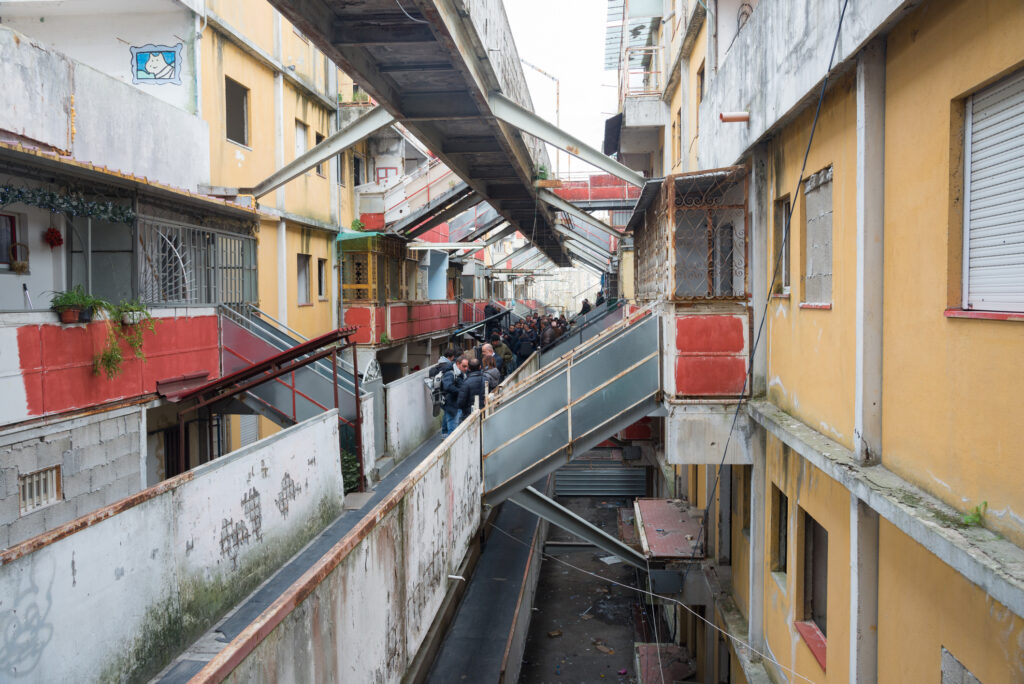
In architectural terms, the Sails were an inhospitable place for the Law. There were various central walkways in the buildings called “espinas” (thorns), which connected the flats at different heights. The labyrinth of connection points between the properties, the number of floors and these walkways, made it impossible to catch criminals. Once in the Sails, the police gave up on any criminals that managed to reach one of these buildings. In addition to the depression caused by the economic climate in the area, there was the issue of a style of architecture that did little to assist the authorities.
Lack of public resources in the area
Despite all the above factors, the Sails could have stood a chance. The state or municipal government should have invested in an industrial belt, higher education or vocational training centers to provide a way out of the poverty in the area. This was not the case and crime moved into the space instead. Having reached this point, the deterioration process was unavoidable. This suburb of Naples had entered a downward spiral.
The influence of police in urban development
Making a location defendable, even in internal terms, has been a historic concern for both military and urban planning strategists. And the Naples of the mid-20th century followed the community policing approach followed by other European cities. As cities grew (Naples had around one million inhabitants), there was a need to distribute the law enforcement agencies and another form of urban facilities (fire departments, hospitals, schools) across the city.
With regard to the Sails, the only feasible response was to establish a police station in front of the buildings. The Commissariato Scampia was completed in 1987 and since then, the police pressure on the area has been notable. “With due respect to Inspector Spina, we need to steal or whatever it takes” commented a resident in 2015 in a documentary. Others complained about the police pressure from the police station. Without basic work skills, for many residents, petty crime, such as selling contraband cigarettes and clothing, seemed to be the only feasible work options.
A new life for Scampia and its Sails
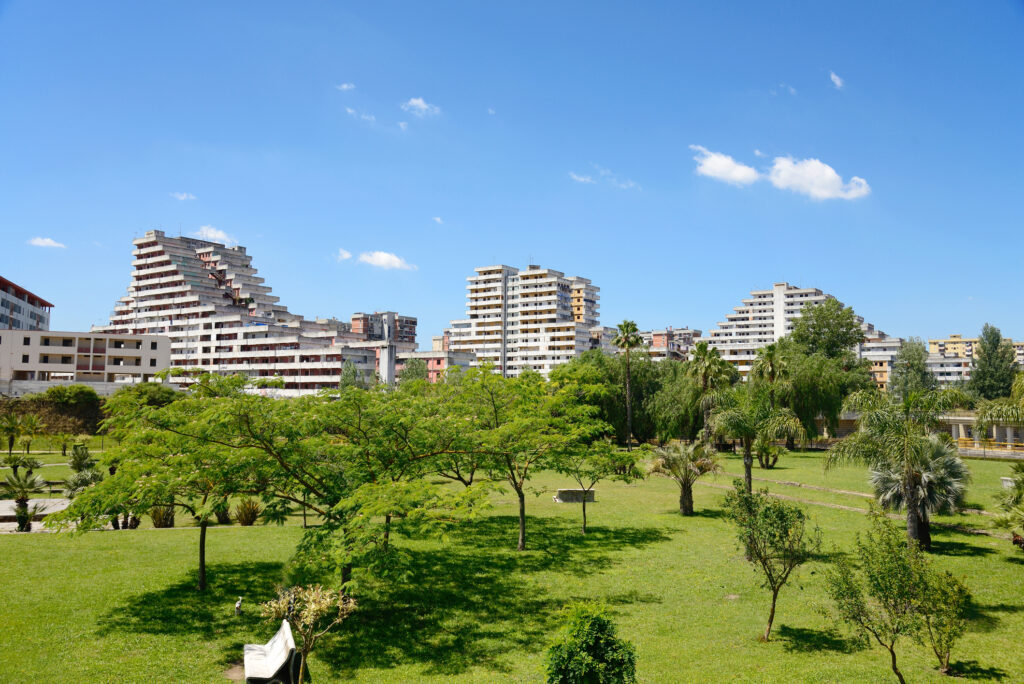
Naples is facing a paradox in the 21st century. On one hand, it has become trendy and one of those cities that go viral on social media. On the other hand, it still has to confront the issues of urban decay and poverty in some of its neighborhoods. Scampia remains synonymous with a troubled district. In fact, it is still included in the classic lists of Naples’ most dangerous neighborhoods for tourists, with the Sails of Scampia still mentioned as a place best avoided. Even so, Scampia is also a well-known area, having entered global popular culture. It is the setting for series like Gomorrah.
The Sails of Scampia never became the “vertical village” Franz Di Salvo had planned, nor was it a utopian oasis for its residents. Furthermore, the buildings did not withstand the test of time. In fact, in 2024, the balcony of one of the Sails, the Blue Sail, collapsed, killing three people. Since the late 1990s, the need to regenerate this urban space and address its problems has been recognized. The local government has committed to demolishing the Sails of Scampia and reinventing the area.
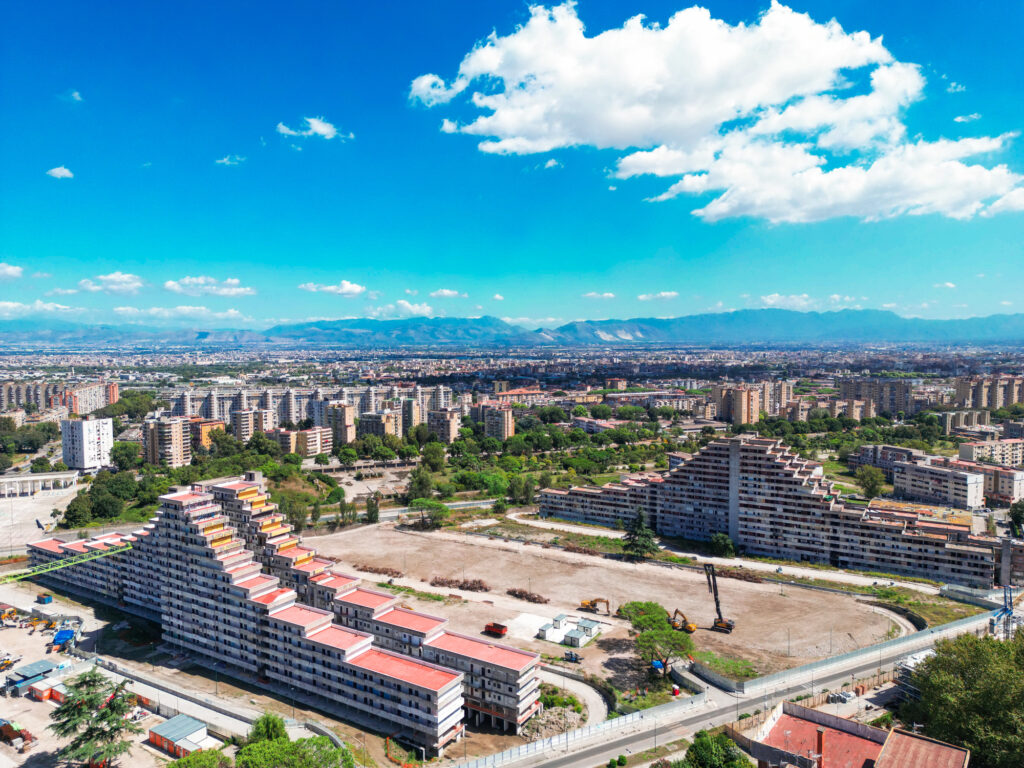
Of the seven large apartment complexes that originally made up the Sails of Scampia, only two buildings remain. The first four were demolished in 1997, 2000, 2003, and 2020. In 2020, it was estimated that the remaining demolition would require a budget of around 18 million euros, plus an additional 120 million euros to redevelop the area for new uses.
In 2024, residents who still lived in the complex were informed that they had to leave the Sails. The relocation allowed authorities to determine the fate of the remaining buildings. In 2025, the Yellow Sail, also a symbol of the Camorra, was demolished in 40 days. “We are doing everything possible to try to solve a problem that has existed for decades” and to eradicate “housing conditions that were not those of a civilized country,” stated the mayor of Naples, Gaetano Manfredi, at the time.
The two remaining buildings will have quite different futures. One of them will also be demolished, while the other is being renovated as office space for the municipal government, preserving a piece of this brutalist urban heritage. On the site left vacant by the Sails that have already gone, one of the faculties of the University of Naples has already been built.
Urban challenges in 21st-century Naples
Regenerating Scampia is one of the urban challenges Naples faces, but it is not the only one. The city has other urban transformation initiatives underway to address its social, environmental, and poverty-related gaps. For example, a Zaha Hadid project is attempting to connect the eastern part of the city by bridging a stretch of railway tracks that acted as an urban barrier, and the Bagnoli project aims to turn a disused steel plant into a green area.
The city is also facing a tourism boom, with its streets and the slightly decayed charm of its historic center being seen as romantic and Instagrammable. Even short-term rentals now occupy central spaces in the city. “Naples is trending on social media,” declared The New York Times, at the beginning of 2025, while the city still has one of Italy’s highest youth unemployment rates (43%) and is experiencing a rise in violence. These are precisely the issues that were at the heart of the failure of the Sails of Scampia.
Images | Mirko Bozzato, Rafael_Wiedenmeier/iStock, Flyres/iStock, enzodebernardo/iStock, enzodebernardo/iStock, Rafael_Wiedenmeier/iStock