Table of Contents
Author | Jaime Ramos
Information technologies and artificial intelligence have opened up a whole host of opportunities. Undoubtedly, the degree of citizen engagement in urban processes offers a potential unseen until now. Can these tools be used to boost urban safety?
Citizen involvement for safety
The participation of members of a community is essential in terms of fostering healthy groups, cultivating a sense of belonging to a community and, in general, community wellbeing. Local authorities are aware of this trend, which also includes the area of security and protection.
Public security services, such as police forces, benefit from relationships of trust among the population and these groups. That level of public involvement can lead to a better integration of police services.
The U.S. web platform, Police1, illustrates some examples of police agents who highlight the importance of strengthening bonds. The Chief of Police, Janie Schutz, explained that “in a democracy, effective police are reliant on citizen cooperation at minimum”.
In her article, she highlights the importance of citizen involvement when investigating crimes. In her experience, she refers to the citizen collaboration that helped catch one of the perpetrators of the Boston Marathon terrorist attack: “a member of the community consciously decided to get involved and thanks to that something good happened”.
Technologies that foster involvement for safety
If we add to this desired relationship of trust between citizens and security services, all that state-of-the-art technologies can offer in terms of protection, we have before us a whole new scenario.
Of course, the effect of citizen involvement through these methods also comes with ethical and moral challenges in terms of privacy and freedom, as with the proliferation of CCTV, mass sensorization or the establishment of social control frameworks. After all, there are many apps that are reminiscent of the iconography of Dystopian works such as ‘1984’.
In any event, today there are numerous digital tools aimed at creating stronger connections between citizens and public protection services.
Digital participation platforms
Although they include countless features to strengthen institutional communication with communities, the services offered by platforms such as Ave Point or Citizen Lab may help prevent future problems. They do so by offering a digital listening platform. Seattle’s inclusion plan is a good example of how to make citizen engagement more available to the wider community through various virtual activities.
Citizen security and information management apps
These types of tools are also becoming more generalized and more successful. In the United States, My mobile witness is a good example, an app that allows online complaints to be submitted and images of suspicious activities can be sent to the country’s security services.
Another aspect of this involvement is how to channel the information obtained from citizens’ collaboration. The Japanese multinational NEC offers another platform that contributes to the management of the same.
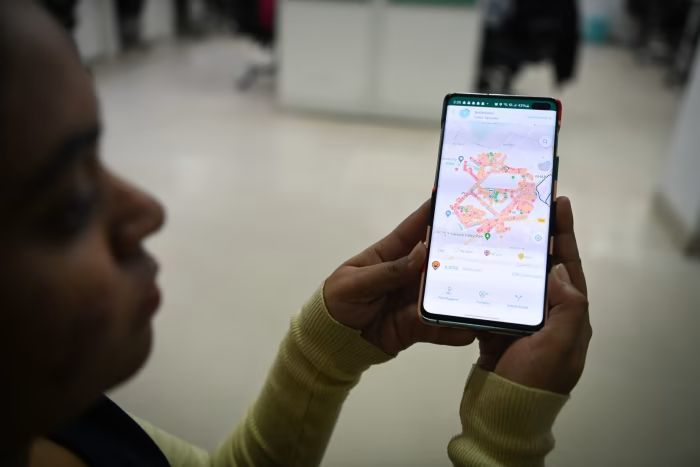
My Safetipin is another, different, example of how technology can be molded and adapted to urban requirements but with more social awareness. It enables new types of parameters to be reported, which end up geolocated, from lighting, to the presence of police, women, children and even the perceived sense of safety.
The original idea of this app based in India began by identifying safe spaces for women and, in general, for everyone. One of the founders, Kalpana Viswanath, explains that building safer cities for women means safer cities for everyone.
Images | Freepik/freepik