



Table of Contents
Author | Jaime Ramos
Defining the long-term future of cities involves using the imagination to the point of bordering on fantasy. What will happen a century from now? How will urban spaces adapt in order to respond to the challenges ahead, such as large populations, migratory movements or the progression of the economy and lack of resources?
Man’s imagination is already providing us with visions to answer these questions. While some insist on looking to the stars as an escape route, others are determined to improve the evolution of our planet. This generates solutions which, as with the space project, form part of science fiction. However, it deserves credibility when the United Nations has, officially, joined the plan to create the sustainable floating city concept.
Oceanix City: the origin of floating cities
This is how the UN recently held the first ever round table to discuss floating cities on water. Far from being an extension of a novel by J. G. Ballard, this round table included a group of experts with perfectly studied and specific projects. The round table included the CEO of the company Oceanix, Marc Collins Chen; the Bjarke Ingels group or the MIT Center for Ocean Engineering, among others.
The session determined the actual capacity of humans to colonise oceans. And, should this be implemented, the formula to do so in a sustainable manner was explored and the advantages it would provide for us. The truth is that two thirds of our planet is covered with water.In fact, this liquid, which is the origin of life, is also under threat as a result of rising sea levels due to climate change. Therefore, the purpose of these types of projects has to be to redesign a 100% sustainable form of urban infrastructures, with the exception of doing so in an aquatic environment.
Aquatic colonies
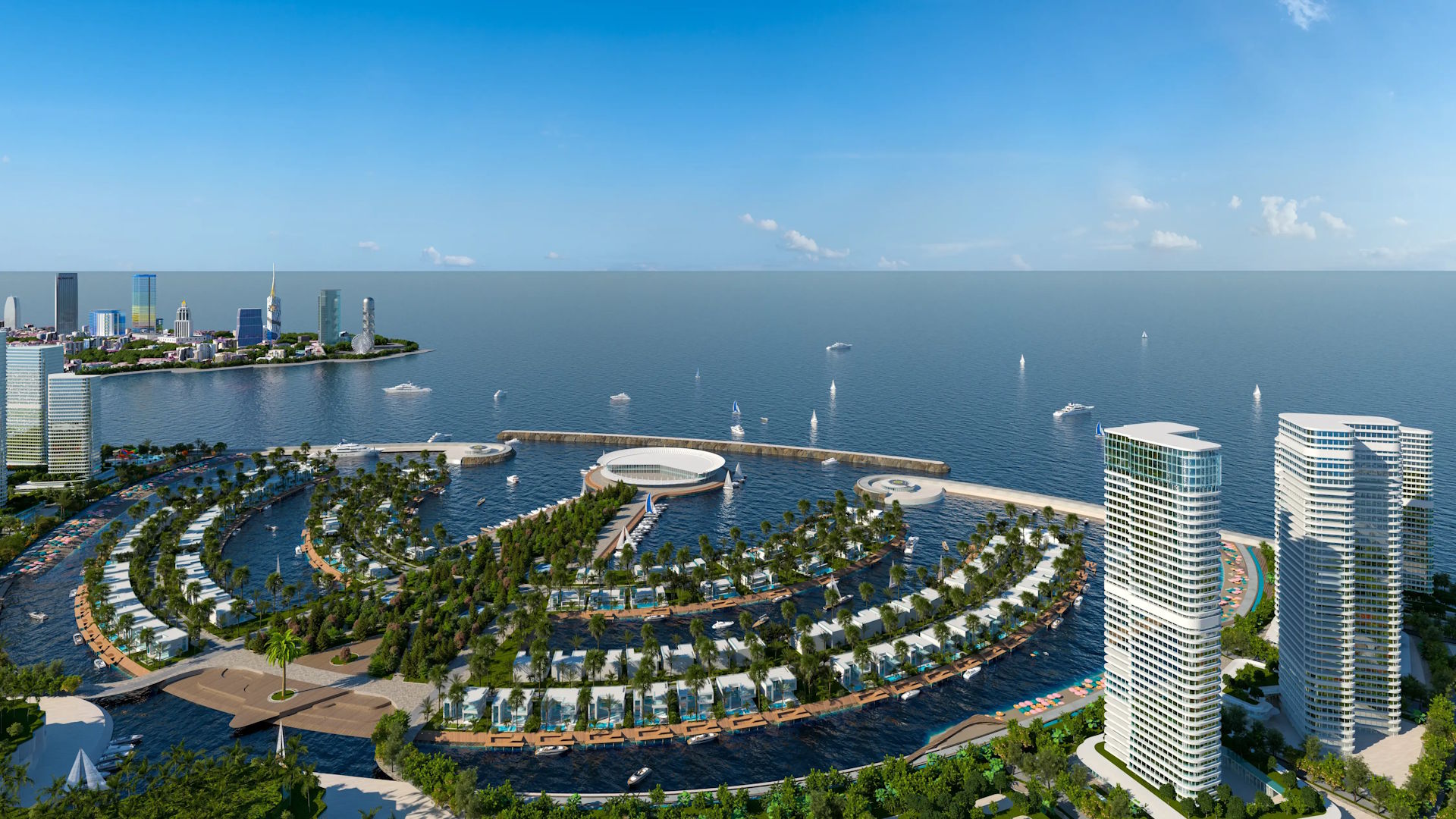
This is why the Oceanix project, a true aquatic village, is designed to grow and transform organically over time, starting with small aquatic neighbourhoods designed as modules. These elements respond to the first habitability requirements of a city. The aquatic colonies would consist of seven-storey buildings, enabling them to create a consistent centre of gravity to withstand strong winds.
Six of these modules arranged in a circle, would form a small urban concentration of 12 hectares, which would be able to house 1,650 residents. This type of aquatic village would meet the social, labour, commercial and leisure requirements, applying the sustainability criteria of smart cities.And, of course, this modular structure would be able to be connected to other hubs. Therefore, these cities can grow without limitations by adding modules and with the advantage of not having geographical boundaries. However, certain challenges do need to be resolved, such as how they would withstand extreme weather conditions.
Escape route for overpopulation
We are already populating the seas. In Lagos, a city that could have 61 million inhabitants by 2100, the lack of land in the surrounding areas is leading the population to choose floating cities. This is not a scene from a science fiction movie. It is the reality of the second most populated city in Africa.
The UN, in turn, insists that these initiatives are being considered as a resource for an uncertain future, in which water may be an inconvenient obstacle for human development. This is due to phenomena such as climate change. For example, cities such as Bangkok have areas that are sinking by around 2 centimetres each year. Recovering the lost space could be an alternative solution for the creation of new cities to alleviate the pressure exerted on existing cities.Images | iStock/Kesu01, Oceanix, iStock/studiof22byricardorocha