



Table of Contents
Author | Lucía Burbano
The cement industry accounts for approximately 7 to 8% of global carbon emissions, making decarbonization essential. Carbon-capturing concrete addresses this challenge through measures such as offsetting emissions generated during cement production, the most carbon intensive stage in the manufacture of the material and is already being used in large scale infrastructure and construction projects.
What is carbon-capturing concrete and how does it work?
Low-carbon concrete refers to technologies that reduce, reuse, or permanently store carbon dioxide (CO₂) during the production or curing of concrete. The goal is to lower its climate impact, although the main source of emissions is one of its key ingredients: cement, which releases CO₂ both through fuel consumption and the heating of limestone.
How carbon-capturing concrete works
Several mechanisms are used, but the two main approaches are:
This is currently the most commercially advanced approach. CO₂ is injected into fresh concrete or during the curing process, where it reacts with calcium compounds to form stable calcium carbonates. These carbonated minerals then become part of the concrete matrix, permanently storing the carbon.
Replacing cement with CO₂ derived materials
The second approach replaces cement with industrial byproducts such as fly ash, calcined clays, or synthetic aggregates produced from captured CO₂. By reducing the amount of clinker, the most carbon-intensive component of cement, indirect emissions are also reduced.
What are the benefits of using carbon-capturing concrete?
Lower embodied carbon
Embodied carbon refers to the emissions generated before a building is occupied. One of the key advantages of carbon-capturing concrete is that it reduces total life cycle emissions before the building begins to generate additional emissions through its use.
Improved material performance
Some mineralized concretes offer higher compressive strength, faster curing, greater durability in certain applications, and compatibility with existing infrastructure. Many of these technologies are designed to integrate into ready mix concrete plants, precast facilities, and existing construction workflows.
Supports circular economy goals
Some systems reuse captured industrial CO₂, demolition waste, or industrial minerals, helping to support circular economy strategies.
How carbon-capturing concrete is used in sustainable infrastructure
Carbon-capturing concrete is increasingly being used in infrastructure projects that require large volumes of concrete, as performance is now being evaluated across the entire life cycle of a structure rather than solely on the initial cost of the material.
Examples of buildings and infrastructure using carbon-capturing concrete
Heirloom Demonstration Project
In 2023, a demonstration project incorporated CO₂ captured directly from the air into the concrete manufacturing process, where it was permanently mineralized within the material. The resulting concrete was used in construction projects across California’s Bay Area.
Heidelberg Materials Plant in Brevik, Norway
This project takes a slightly different approach. Instead of capturing CO₂ directly from the air, hundreds of thousands of tons of CO₂ generated during post combustion at the cement plant are captured each year through a chemical process before being transported for permanent storage.
This railway tunnel forms part of the high speed rail corridor linking Vitoria, Bilbao, and San Sebastián and uses low carbon concrete for civil engineering works. According to the project, these concrete mixes have reduced emissions by approximately 46% compared with conventional concrete.
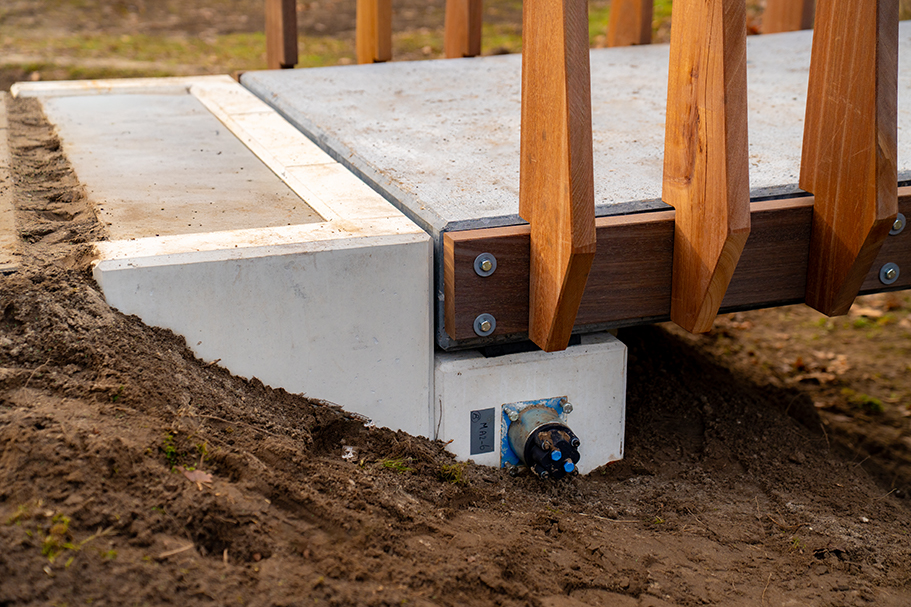
Pedestrian Bridge, Rosmalen, the Netherlands
This engineering landmark demonstrates that concrete can achieve climate neutrality without compromising strength or safety. It also captures and permanently stores 66 kilograms of CO₂, while 75% of the raw materials used are sourced from circular materials.
Frequently asked questions about carbon-capturing concrete
What is carbon-capturing concrete?
Carbon-capturing concrete stores CO₂ by injecting it during the mixing or curing process, where it is converted into stable minerals within the concrete.
What are the benefits of using carbon-capturing concrete?
It reduces embodied carbon, can improve material performance, and lowers reliance on traditional cement.
Is carbon-capturing concrete a viable solution for reducing emissions in the construction industry?
Yes, but only as part of a broader strategy that also includes low carbon cement, greater energy efficiency, and carbon capture technologies.
What are the main types of carbon capture and utilization (CCU) in concrete?
The main approaches include CO₂ injection during mixing, CO₂ curing, carbonated aggregates, and CO₂ based binders.
Photos | Unsplash/Jonny James, Paebbl