



Author | Lucía Burbano
Avant-garde since its inception, architect Frank Lloyd Wright’s vision for the Guggenheim Museum and the bold decision to hire him by Hilla Rebay, Solomon R. Guggenheim’s art advisor, broke all previously known conventions of museum design.
A century and several decades later, the Guggenheim Museum in New York still preserves this rebellious spirit, committed to bringing together art and innovative technologies, while its architecture remains just as relevant.
The Guggenheim in New York: a building or a work of art?

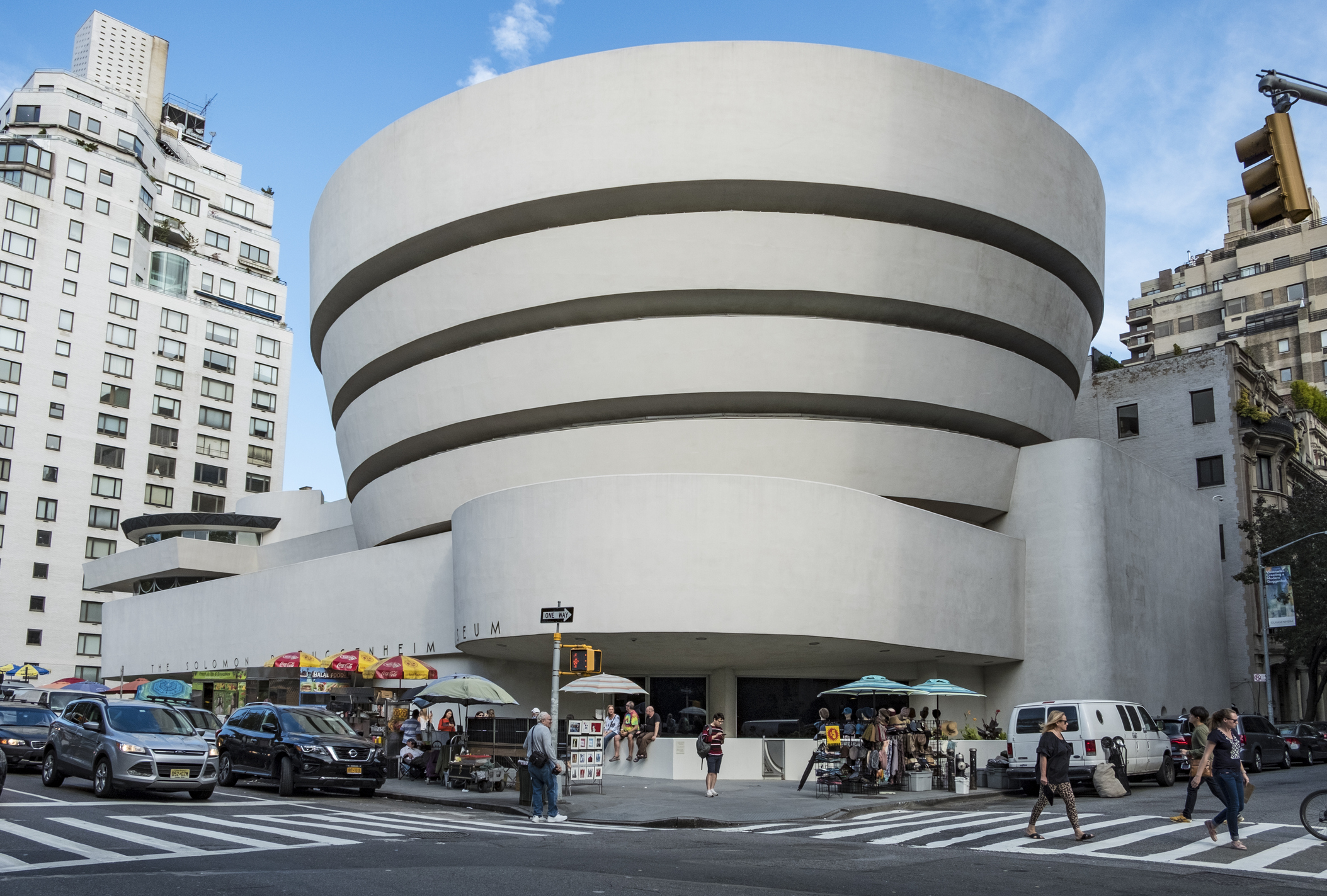
Designed by legendary architect Frank Lloyd Wright, the Guggenheim Museum in New York is a concrete and organic architecture masterpiece, with its spiral shape at the top making it a unique space for showcasing modern art.
Its story began in 1943, when architect Frank Lloyd Wright received a letter from Hilla Rebay, art advisor to American art collector and philanthropist Solomon R. Guggenheim, asking him to design a new building to house Guggenheim’s radical art collection developed by artists such as Vasily Kandinsky, Paul Klee, and Piet Mondrian.
The only requirement the philanthropist imposed on the architect was that the building should not resemble any other museum in the world. Wright, for his part, created a design that he believed would be “the best possible atmosphere in which to show fine paintings or listen to music.” Originally named the Museum of Non-Objective Painting, it was renamed to its current title in 1952, three years after the death of Solomon R. Guggenheim.
However, as has often been the case with many boldly designed buildings, Frank Lloyd Wright’s unconventional design for the Guggenheim Museum did not escape controversy. Some critics argued that its architecture failed in its purpose, claiming it overshadowed the artworks displayed inside.
And just weeks before its opening on October 21, 1959, several artists signed a letter protesting the display of their work in a space with curved walls that forced paintings to tilt backward, like on an easel. The design proved impractical, as the concave surfaces made it challenging to properly exhibit the artworks.
Frank Lloyd Wright and the organic architecture of the Guggenheim Museum
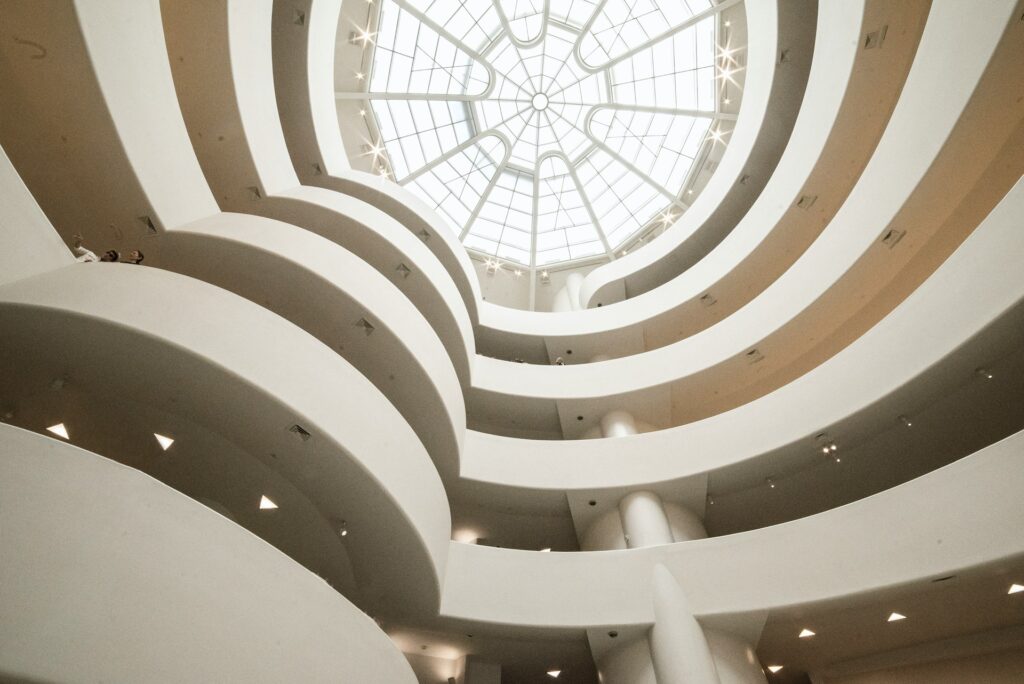
Curved walls, ramps, membranes dividing the different galleries… The Guggenheim Museum in New York is a showcase of Wright’s efforts to incorporate organic forms into architecture and give it greater fluidity and plasticity.
The architect himself described the Guggenheim’s steel framework as tendons and muscles, illustrating his belief that buildings should function like living organisms, products of their time, and deeply connected to a specific moment and place.
His design for the new building broke away from conventional museum architecture, featuring a stacked cylindrical exterior made of reinforced concrete that rises toward the sky. These dramatic exterior curves are fully realized inside, where Wright guides visitors to the top of the building via an elevator, then leads them down a gently sloping continuous ramp spanning six floors and over a quarter of a mile in length. This allows each level to flow naturally into the next as visitors experience the artwork displayed along the curved walls.
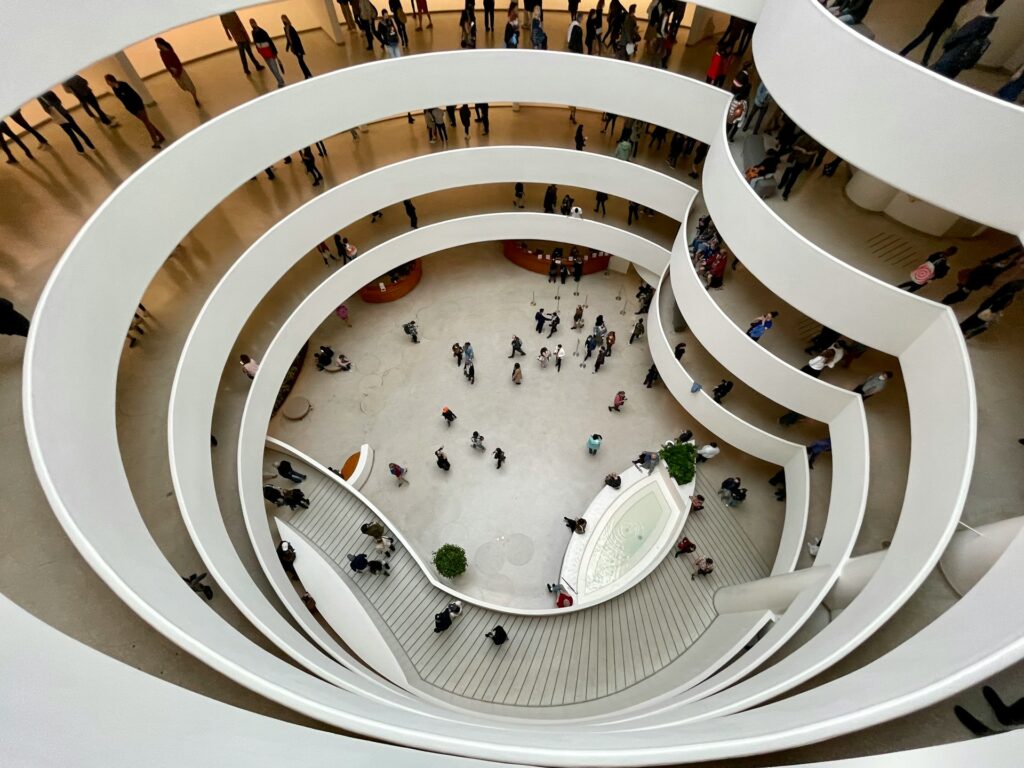
The open views of the atrium also allow for interaction between people on various levels, enhancing the sectional design. And if you look up, the ceiling is crowned by a central skylight that lets in natural light.
Wright’s design includes details inspired by nature, while also expressing his take on the rigid geometry of modernist architecture. For instance, the galleries are divided by membranes reminiscent of citrus fruits, separate yet interdependent sections.
The architect himself described the symbolic meaning of the building’s shapes: “These geometric forms suggest certain human ideas, moods, sentiments – as for instance: the circle, infinity; the triangle, structural unity; the spiral, organic progress; the square, integrity.”
The Guggenheim Museum in the 21st Century
With over a million visitors annually and as an icon of New York City, the Guggenheim Museum ties its artistic and operational future to technology.
One example of this is beacon technology, a type of device that uses low-energy Bluetooth signals to send information to nearby mobile devices. This technology enables the museum to track how long visitors spend navigating an exhibit and identify which artwork captures their attention the most, helping to improve the flow of visitors.
When it comes to curating, the New York museum is increasingly dedicating space to art connected to innovative technologies through the LG Guggenheim Art and Technology Initiative, which supports artists who use technology as an artistic medium and explore how it shapes, and is shaped, by society.
Some projects include research into making Artificial Intelligence more accessible and inclusive, based on the need to develop algorithms with a broader perspective that better reflects the real world.
Another artist creates virtual environments using emerging technologies that combine live action, motion capture, and animation software to transform firsthand research and documentary fieldwork into immersive speculative worlds.
One can only wonder what Solomon R. Guggenheim and Frank Lloyd Wright would think of this focus, but they would surely approve of the art-technology pairing. Guggenheim, because he already championed the abstract and avant-garde, and Wright, because he broke architectural norms in museum design.
Photographs | travelview/iStock, Nicholas Ceglia/Unsplash, Taylor Heery/Unsplash, David Emrich/Unsplash