


Authors | Jaime Ramos, Raquel C. Pico
City skies are heading towards a turning point. As if it were a sci-fi movie, numerous cities and companies are designing an Urban Air Mobility (UAM) model with air taxis to revolutionize the mobility sector. Among these is New York.
What is urban air mobility and how does it differ from conventional helicopters?
Until now, the term air taxis has been used to describe flight services offered by helicopters or small aircraft, for non-commercial purposes and affordable only to a lucky few.
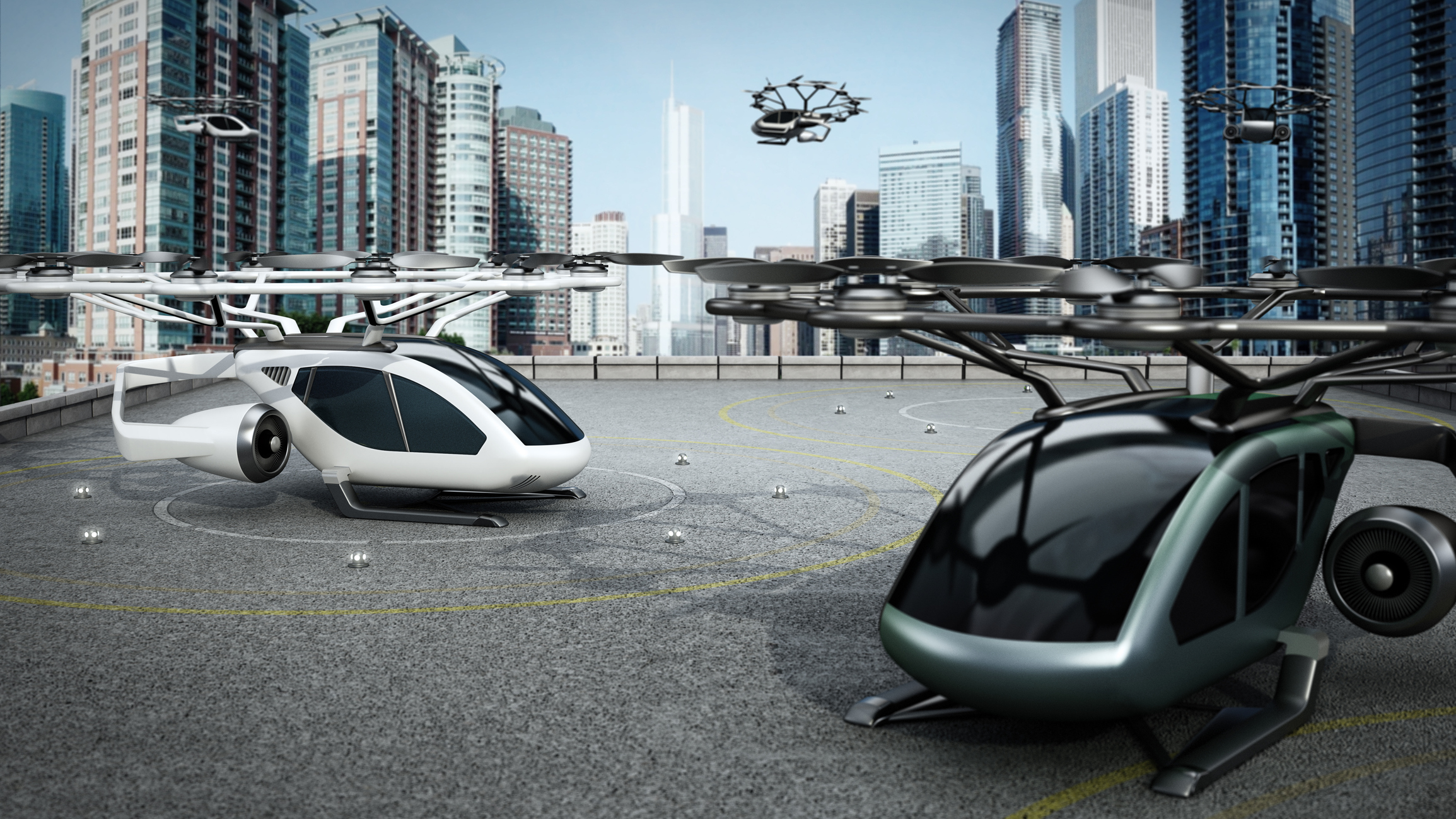
In recent years, a new trend has emerged in the air mobility sector. On the one hand, we have the arrival of a new type of vehicle, the eVTOL (all-electric Vertical Take-Off and Landing), a kind of drone evolution capable of transporting people, with advantages that make these aircrafts lighter and more sustainable. These characteristics mark a new chapter in terms of the previous helitaxi services.
The highly versatile nature of these devices, capable of reaching places inaccessible to helicopters, makes them ideal to be managed through a network of small aerial stations in cities. This has led many cities to already envisage this service for internal urban trips.
New York’s plans and its air taxi services
Mobility is one of the biggest challenges faced by major cities. Traditional taxi services are often overwhelmed by high demand, especially during rush hours or times that require additional urban transportation resources. This is where the potential of flying vehicles has been explored for decades, as they could offer a solution to these challenges.
This is why it comes as no surprise to see flying car plans in Dubai or to see New York emerging as a pioneer in experimenting with urban mobility through air transportation.
New York takes its first flights with eVTOL
So, despite the enormous technical challenges (the batteries are still awaiting implemented developments) and the operational challenges that developers are facing, projects and dates were already being considered a couple of years ago to initiate experimental flights. One of the most talked about was New York City’s plan with two companies, Joby and Volocopter.
It seems that the authorities want to step to the fore with eVTOL, providing the infrastructure required and helping with the regulatory framework. At the end of 2023, the city’s mayor, Eric Adams, announced the city council’s intention, with a plan designed to revolutionize the city’s skies in order “to be able to, firstly, move faster to and from our places, the airports and other locations, but to do it in a clean way.”
Adams’s speech coincided with the first eVTOL flight by the aforementioned companies in New York, which took off from the Manhattan Heliport. Apart from the New York authorities, Joby have indicated that they are working with authorities in New Jersey and with Delta Air Lines for their eVTOL plan.
Air Mobility in New York Today
Of course, plans and projects are one thing, and reality is another. The truth is that, as of 2025, New York’s skies are not filled with air taxi services, but that does not mean the idea has been forgotten or stalled. There are ongoing projects aimed at building an urban mobility network based on air transportation.
This spring, the company Archer unveiled a project that will make it possible to travel to the city’s airports by air. “The New York region is home to three of the world’s preeminent airports, serving upwards of 150 million passengers annually. But the drive from Manhattan to any of these airports can be painful, taking one, sometimes two hours,” explains Archer CEO Adam Goldstein. The company aims to cut that down to just 5 to 15 minutes using its own piloted air taxi, called Midnight. Departure points will be in Manhattan.
The project is being launched in partnership with United Airlines, and as U.S. media reports point out, travelers will be able to purchase these trips as an add-on when booking their flights. For now, Midnight has not yet been certified to fly, and the company must wait for that approval before beginning operations. As a result, it is still unclear when the service will launch and when New York will be connected to its airports by air taxi.
For its part, Joby Aviation—another company seen as a potential game-changer in New York’s air taxi market—is finalizing its aircraft. It is expected to launch its services in the United Arab Emirates in 2026. By late 2023, it had already completed an experimental test flight in New York.
When will air taxis be flying around cities?
The debate over whether air taxis are the future of urban mobility has been going on for years. When the mayor of New York spoke about their potential in 2023, it was already clear that bringing them into practical use on the city’s streets would still require time, work, and further development.
At the time, it was estimated that the development of eVTOLs would largely depend on the steps taken between 2024 and 2027. One of the Vice Presidents of the consultancy firm ICF, believes that the latter date is more realistic. He comments in Travel Weekly that it is a new type of aircraft that requires a series of certifications that would delay its introduction in the United States, with respect to other places such as Germany or China. China has already granted the first certification for EHang’s vehicle EH216.
The U.S. Federal Aviation Administration (FAA) expected planning with various stages: first following helicopters’ current route, to later establish corridors between airports and vertiports in the city center. There are also plans for a future of autonomous flying for these vehicles. This is a promising scenario for city skylines like New York. According to Lee, once operational, the demand for the service in U.S. cities will reach 200 million trips per year.
In the summer of 2025, the U.S. government signed an executive order aimed at accelerating the development of drones and testing of flying cars. According to U.S. media, the order paves the way for testing these flying vehicles and sets a regulatory framework for the take-off and landing of eVTOLs.
Criticism of eVTOLs
Still, the rise of sky taxi services is not without its concerns. Flying vehicles may look futuristic, but they are far from being an accessible urban transportation solution for the general public. Air travel will not come at the price of a subway ticket.
On top of that, early critics are already raising questions about the potential impact on urban noise pollution and the consequences of building helipads within city infrastructure. The big question is where these facilities will be located and what will be sacrificed (and for which segments of the population) to make room for them. There are also concerns about whether this could overload air traffic and complicate airport operations. After all, these flying taxis are being introduced in densely populated cities with already high volumes of air travel.
Image | Volocopter