



Table of Contents
This is a guest post by Lucía Bellocchio, founder and executive director of Trend Smart Cities. Lucía has extensive experience working on urban innovation, and has written in leading media outlets in South America like La Nación, El Observador, Clarín or TN.
For decades, cities have been designed around an implicit assumption: that everyone experiences urban life in roughly the same way. Streets, transportation systems, parks, public services, and digital platforms have largely been conceived for a “standard citizen” capable of navigating noise, uncertainty, crowds, and constant stimulation. Accessibility policies have traditionally focused on removing physical barriers, while urban innovation agendas have prioritized efficiency, connectivity, and sustainability. But what if we started asking a different question? What would cities look like if we designed them around the experiences of autistic people?
This question lies at the heart of Blue Cities: Accessible, Sensitive and Empathetic, our recently published book, co-written with urban planner Álvaro García Resta. Drawing from both professional expertise and lived experience as parents of autistic children, the book proposes a new framework for understanding cities through the lens of neurodiversity.
Far from being a niche agenda, designing for neurodiversity offers an opportunity to rethink cities for everyone: children, older adults, people with disabilities, and anyone who experiences urban environments differently.
In this sense, Blue Cities represent the next step in the evolution of urban thinking. If twentieth-century cities were shaped by infrastructure and productivity, and more recent agendas have rightly emphasized sustainability and climate resilience, the challenge ahead is to create cities that are also legible, predictable, and caring.
The challenge is not to replace smart cities with Blue Cities, but to evolve from cities centered on infrastructure toward cities centered on human experience.
Inclusion as a Starting Point
Inclusion cannot be treated as the final objective of urban planning — it must be its starting point. Human diversity, in all its sensory, cognitive, and physical dimensions, should be recognized as a structural condition of city life rather than an exception to accommodate later. Designing for the “average user” inevitably excludes millions of people whose experiences do not fit the norm.
Building Blue Cities means involving neurodivergent communities from the earliest stages of planning and recognizing that diversity enriches, rather than complicates, urban life.
Sharing Experience as a Form of Knowledge
Urban planning has traditionally relied on technical expertise, data, and regulations. Blue Cities add another essential source of knowledge: lived experience. The daily experiences of autistic people and their families reveal aspects of the urban environment that often remain invisible to planners and policymakers. Their perspectives help identify hidden barriers, understand sensory challenges, and imagine alternative ways of inhabiting public space.
As Carlos Moreno writes in the foreword to Blue Cities, knowledge does not emerge apart from life —it emerges from it. Listening, collaborating, and co-creating are therefore not optional exercises in participation, but essential tools for designing better cities.
Feeling the City
Urban experience is never neutral. Every street, station, square, and public building generates sensory and emotional responses that shape who feels welcome — and who does not. Noise, lighting, textures, smells, crowd density, and visual complexity influence the way people inhabit the city.
For decades, urban success has been measured through indicators such as speed, productivity, and efficiency. Blue Cities propose complementing those metrics with a new set of questions: How does a place feel? Does it reduce anxiety or amplify it? Does it invite people to stay or push them away? Cities should not only function well; they should feel good.
Anticipation as a Form of Urban Empathy
Uncertainty can be one of the greatest barriers to inclusion. For many neurodivergent people, navigating an unfamiliar environment requires significant cognitive effort. Unexpected changes, unclear information, or unpredictable situations can turn everyday experiences into sources of stress.
Blue Cities understand anticipation as a form of care. Clear information, intuitive signage, accessible maps, predictable mobility systems, and digital tools that help people prepare for urban experiences all contribute to reducing uncertainty. A city that helps people anticipate what lies ahead is a city that creates trust.
Legibility: The Silent Conversation
Cities communicate constantly. Through signs, public transport systems, street layouts, landmarks, and architecture, urban environments send signals that people must interpret in order to move safely and independently.
Legibility is the ability of a city to be understood. It depends on structural clarity, coherent wayfinding systems, and environments that reduce unnecessary cognitive load. When cities become easier to read, they become easier to inhabit. Legibility is, ultimately, a condition for autonomy.
The Right to Pause
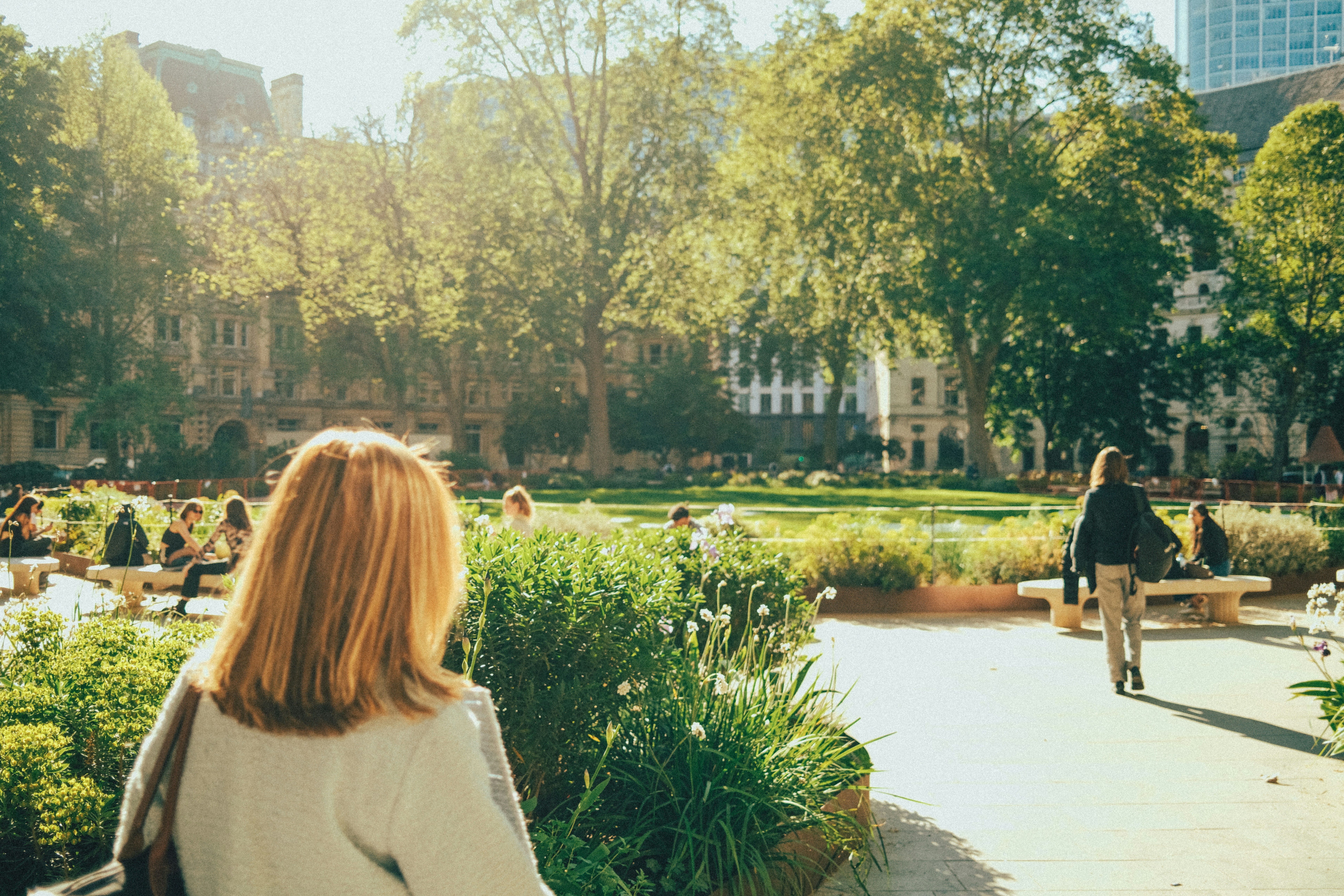
Urban life is often designed around movement, speed, and productivity. Yet inclusive cities must also make room for stillness. Blue Cities introduce the idea of the “right to pause”: the possibility of finding moments of refuge, calm, and gradual reintegration into the rhythms of urban life. Shade, silence, seating, green spaces, transitional areas, and quieter environments should not be seen as secondary amenities but as essential emotional infrastructure. The ability to pause is not a luxury. It is a prerequisite for participation.
Social Sustainability
Environmental decisions are also decisions about inclusion.
The conversation around sustainability has rightly emphasized carbon emissions, energy efficiency, and climate adaptation. Blue Cities broaden this perspective by incorporating social sustainability into the urban agenda.
Green spaces, tree canopies, cleaner mobility systems, and quieter environments do more than improve environmental performance — they create conditions for comfort, well-being, and belonging.
The future of cities will depend not only on how sustainable they are, but also on who is able to fully participate in urban life.
Adaptability
No single urban environment works equally well for everyone. Inclusive cities are not rigid systems; they are flexible ecosystems capable of accommodating different rhythms, preferences, and sensory needs.
Adaptability means creating spaces that allow people to adjust their experience without abandoning it entirely. It means designing public spaces, cultural venues, and mobility systems that offer multiple ways of participating. Flexibility is not a concession — it is good urban design.
Empathy as Urban Practice
Empathy is often treated as an individual virtue. Blue Cities propose understanding it as an institutional and professional practice.
Empathy can be learned, trained, and embedded into public policies. It requires listening to autistic voices, understanding different ways of experiencing the city, and equipping urban professionals with the tools to translate those experiences into concrete interventions.
The difference between an inclusive urban experience and an exclusionary one often lies in the city’s capacity to understand the people it serves.
Autonomy Through Technology
Technology should not replace human relationships; it should strengthen them. Digital tools — from accessible navigation systems and sensory maps to real-time information platforms — can help people anticipate, orient themselves, and participate more fully in urban life. In Blue Cities, technology acts as a mediator between urban complexity and individual experience. Its purpose is not to create dependency, but to expand autonomy, accessibility, and inclusion.
The most intelligent technologies are those that help people navigate the city with greater confidence and independence.
A New Urban Agenda
Blue Cities do not offer a universal recipe. They offer something more valuable: a new lens through which to understand urban life. The challenge facing twenty-first-century cities is no longer limited to becoming smarter, greener, or more connected. It is about recognizing that cities are, above all, networks of human experiences.
Designing from the perspective of neurodiversity does not mean creating special environments for a minority. It means acknowledging that there is no single way of perceiving, understanding, and inhabiting the world.
The future of urbanism will not be defined solely by technological sophistication or environmental performance. It will be measured by something deeper: the ability of cities to care for the diversity of human experience. Because, ultimately, the cities that work better for those who face the greatest barriers end up working better for everyone.
Photos by Taylor Heery, Elliot Parker, nicola dowie & Leticia Golubov.