Table of Contents
Author | Lucía Burbano
The world’s rising sea levels have highlighted the urgent need for innovative urban models to address the vulnerabilities faced by 90% of megacities, according to UN Habitat. Climate change, driving rising sea levels that endanger coastal cities, could displace approximately 200 million people annually until 2050.
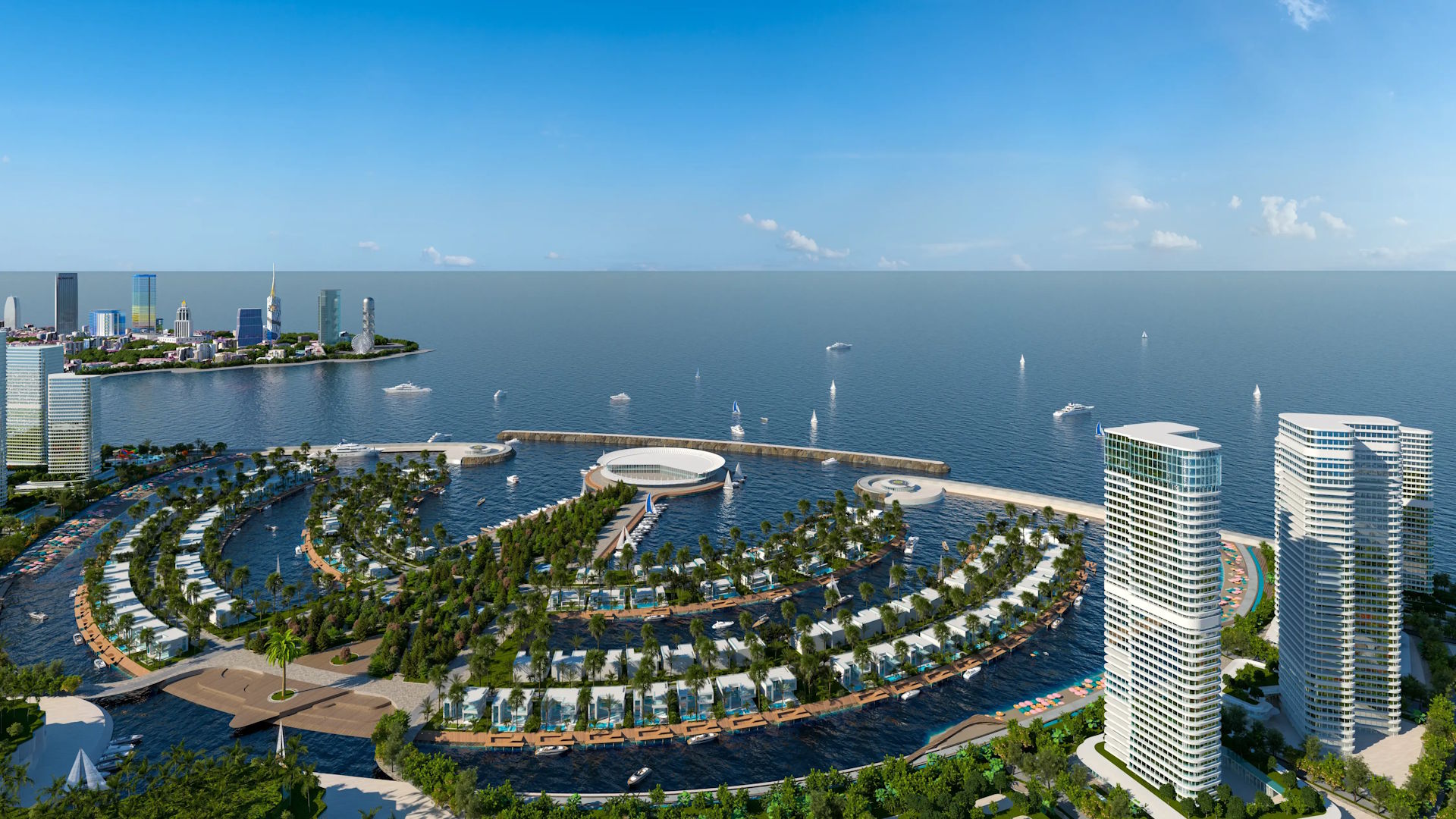
In this scenario, the future seems increasingly directed toward the development of floating cities as a solution to the scarcity of safe and available land. Currently, various projects are underway to reclaim land from the sea, featuring resilient architecture designed to withstand natural disasters. Oceanix Busan is, at the moment, the most promising floating city.
Oceanix Busan, a floating city in South Korea
In addition to addressing the impacts of climate change on cities, Oceanix Busan introduces an alternative urban model that not only prioritizes sustainability but also actively promotes the regeneration of local habitats and biodiversity.
The architectural design of Oceanix Busan is a collaboration between the Bjarke Ingels Group (BIG) and local architects SAMOO. Key partners in this initiative include UN-Habitat—the United Nations program for human settlements—the Busan Metropolitan City of the Republic of Korea, and OCEANIX, a blue tech company founded in 2018 to design and build sustainable floating cities.
The concept of a floating city was first introduced in 2019 when UN-Habitat, a United Nations agency, convened a roundtable of architects, designers, academics, and business leaders to explore whether floating cities could serve as a viable solution to urban challenges like climate change and the shortage of affordable housing.
The discussion addressed various critical issues, including structural and design proposals, suitable locations near existing cities, and how floating cities could provide refuge for those displaced by rising sea levels and other threats stemming from natural or climate-related disasters. Additionally, the potential of these cities to alleviate existing housing shortages was a key topic of debate.
Modular urbanism
In terms of urban planning, this vision of the city of the future brings to life the concepts discussed during the forum, utilizing modular floating platforms anchored in the sea as an alternative to the scarcity of buildable land. It is also a scalable solution, capable of being replicated in coastal cities worldwide and in regions grappling with climate-related challenges.
The interconnected platforms will span a total area of 6.27 hectares, designed to accommodate 12,000 residents. However, their scalable design allows for future expansion to house up to 100,000 people.
Each of the three platforms will be outfitted with photovoltaic panels and greenhouses, designed to be expandable or retractable based on the evolving needs of Busan.
These three platforms are divided into:
Residential platform
Designed for residents, the platform incorporates advanced structural and environmental features aimed at minimizing reliance on artificial energy. These include passive solar heating systems to optimize natural sunlight for warmth and rainwater harvesting systems. Hydroponic systems will ensure the year-round production of organic fruits and vegetables.
The five-story platform, with a maximum height of 20 meters, will cover an area of 6,500 square meters.
Research platform
A collaborative platform for sustainable technologies and an exhibition center. Standing five stories tall with a maximum height of 25 meters, the platform will span an area of 10,500 square meters.
Living Platform
Aimed at promoting sustainable living and providing a range of services for community interaction, its passive solar design maximizes natural light, while its cultural program enriches the community by fostering a sense of belonging. It spans five floors, covering a total area of 8,500 square meters.
The engineering behind the Busan floating platforms
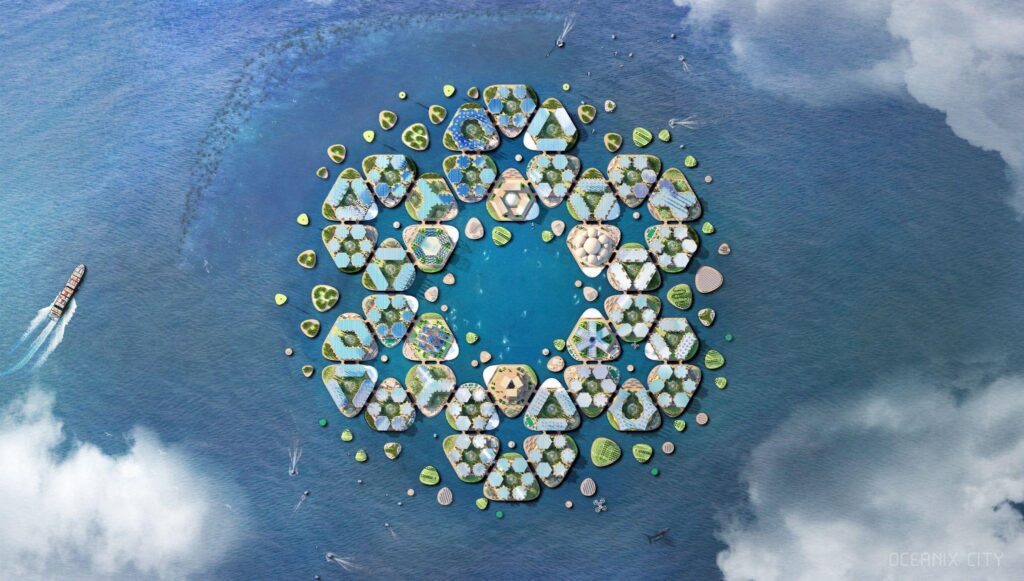
The structural design of Oceanix Busan emphasizes stability, durability, and adaptability to the marine environment. The platforms are engineered to withstand the forces of wind, waves, and currents. They incorporate advanced materials, including reinforced concrete and steel, to ensure robust and durable foundations.
The adjustable tanks and floating foundations are designed to mitigate rising sea levels and extreme meteorological risks, enabling the platforms to rise and fall with fluctuations in water levels. The weight distribution and load capacity are engineered to accommodate the diverse functions and activities planned for each platform.
Designed to withstand the challenges of climate change, the modular nature of Oceanix Busan enables exceptional flexibility and scalability. Self-sufficiency and resource efficiency minimize reliance on external infrastructure while enhancing resilience.
Other floating cities around the world
The ambition to reclaim land from the sea is far from new. In 1968, R. Buckminster Fuller conceived a futuristic design for a floating city, a tetrahedral structure in Tokyo Bay, designed to house one million residents within 300,000 apartment units, featuring an enormous interior port.
Fuller envisioned this unbuilt project as a solution to two enduring challenges in architecture and urbanism: the high costs of construction and the scarcity of available land for development.
Other more current projects are:
The floating city of the Maldives

To counteract the threat of rising sea levels, the Maldivian government plans to establish a floating city by 2027. It is a series of hexagonal islands, drawing inspiration from the patterns of local coral formations.
The city, located near Malé and conveniently accessible from the international airport, is set to float on a 200-hectare lagoon in the Indian Ocean. The city will feature an innovative energy efficiency system: solar panels will generate renewable energy, while deep-sea water will be used to cool buildings, significantly reducing the city’s environmental footprint.
BiodiverCity Penang in Malaysia
Also designed by BIG, it consists of three biodiverse and sustainable islands, situated off the coast of Penang Island, and interconnected by an autonomous transportation network. Each island, shaped like a lily, will feature mixed-use neighborhoods, 4.6 kilometers of public beaches, 242 hectares of parks, and a 25-kilometer-long beachfront promenade.
BiodiverCity aims to become a global destination that fosters sustainable economic and cultural development for Penang Island, all while preserving the biodiversity of its coastal regions and natural ecosystems.
Images | OCEANIX/BIG-Bjarke Ingels Group, Maldives Floating City