



Author | M. Martínez Euklidiadas
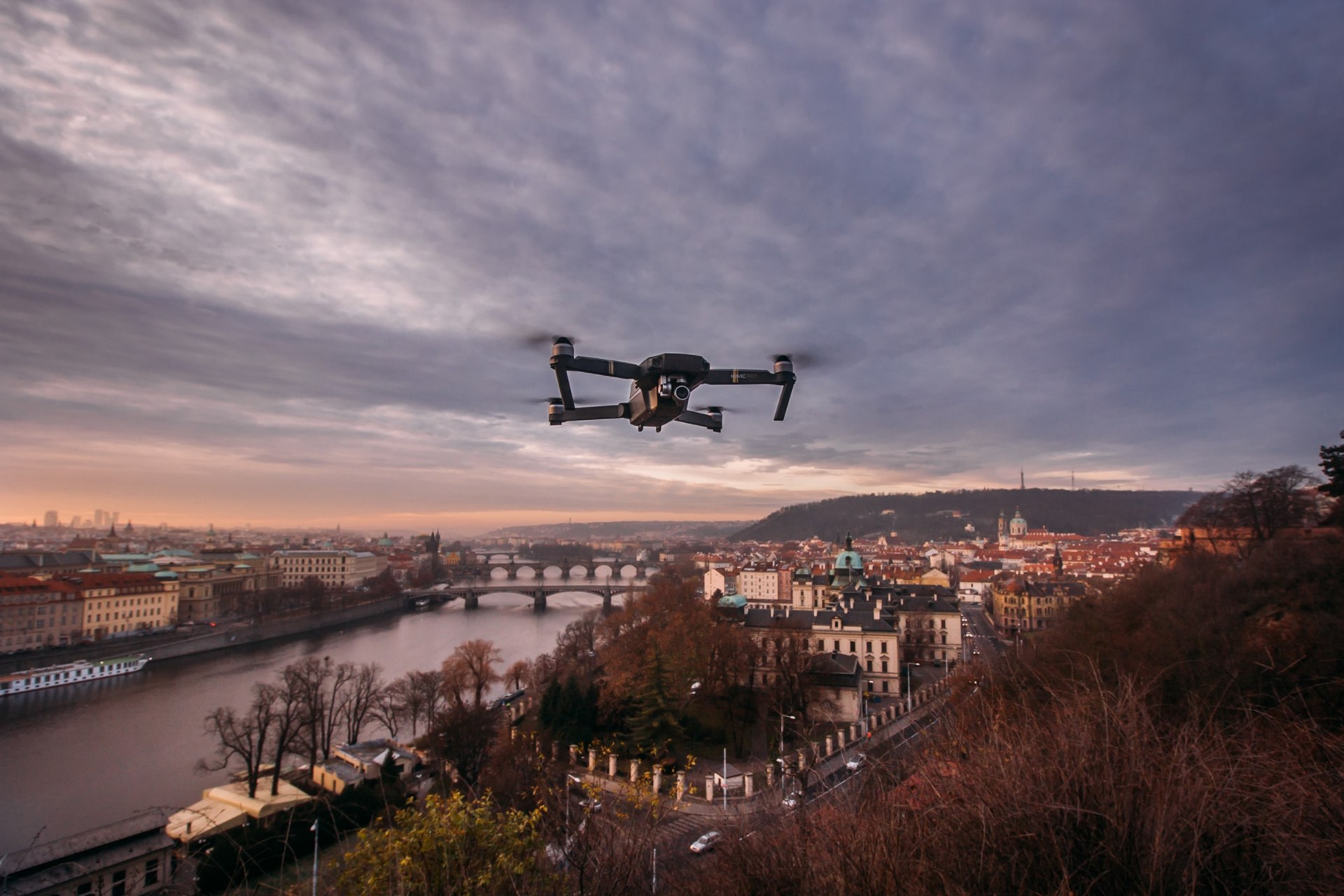
In the social imaginary, delivery drones will be flying over urbanites as cars did in around 1960 in futurology journals. But are drones suitable for cities? What are the challenges?
Are drones allowed to fly in cities?
The control of the air space varies by countries, by regions within these countries and also by cities, therefore, in some towns it is possible to fly drones, while in others it is absolutely forbidden.
In most cases, however, it is an unregulated activity with shades of gray, without any specific regulations in place, and an activity in which permission is granted to fly over certain areas, up to a certain height and at certain times.
What are the problems caused by drone use in cities?

In general terms, there are three major challenges that need to be addressed with drones in urban areas. The first of these is related to objects falling from the sky at high speed, the second is related to privacy and the third refers to the ‘distribution of the sky’ or how to establish air priorities.
Physical damage caused by free-falling drones
Free fall helps us to understand the physical damage caused by a drone when it goes wrong. A 2-kg drone falling from a height of 20 meters has an energy impact of around 400 joules. If the drone hits someone in the head, it would prove fatal with a tenth of that energy, as demonstrated by the Ig Nobel Prize. And if the drone is flying, the impact would be similar.
Violation of public privacy
The laws of physics are universal, but privacy laws are not. In many cities, drones equipped with cameras (for recording or guided) can be used, provided they comply with a series of precepts.
In some cities, drones can be flown using cameras, provided they do not record, or if the recording is for specific public information or journalism purposes, while they cannot be flown if minors are filmed or if permission has not been obtained, for example.
Regardless of the particular municipal rules, it is important to highlight how drones can be used as a surveillance tool, both public (for example for police use) and private (personal security). And this requires a techno-ethics debate.
Problems with air security
A very different issue are the flight laws governing air traffic, although in general lines, even when there are not any specific laws in place that allow drones to be flown, there are rules that prevent flying drones in certain areas or at certain heights.
For example, in areas with regulated commercial air traffic drones cannot be flown under any circumstances, given the danger of collision between the aircrafts and the drones. Normally they are not allowed to be flown next to public buildings, particularly near police stations or government centers.
Potential benefits of flying drones in urban areas
Despite the risks, and provided the relevant regulations are in place, there are some potential benefits to flying drones in urban areas. Of course, they are normally related to their potential challenges.
A typical case is how security services will not have to chase criminals: they will just be able to send out a drone and get to where they are hiding after committing an offense. In a way, they are a miniature version of police helicopters.
Another example is how they could be used for urgent deliveries, such as transporting organs for transplants. Given the extremely high impact of flying rather than driving, general deliveries using flying drones will seldom be justified. However, they will be in more urgent situations.
The use of drones in cities requires the particular challenges to be addressed through legal provisions that protect the population, as in other technologies. Although, as in all these cases, laws tend to lag behind constantly evolving technology.
Cities and countries that are already testing the use of drones for deliveries
The use of drones as delivery platforms for all kinds of items have been explored practically since their inception, but few cities have embraced them with the necessary laws. Here are some relevant examples:
United States, United Kingdom and Italy (Amazon Prime Air)
After a pioneering trial period in the United States, Amazon has announced that by the end of 2024 it will offer its Prime Air home delivery service in several cities in Italy and the United Kingdom. These drones will be responsible for completing same-day express deliveries, initially with one location per country. The cities have not yet been announced, but it is already known that Amazon will take advantage of a new drone, the MK30, which can fly twice as fast as previous Prime Air models.
Besides its new European presence, Amazon has announced that its drones will be integrated in all its logistics centers in the United States and not only in those adapted for Prime Air, such is the case of its warehouses in Lockeford, California and College Station, Texas.
Kaduna, Nigeria and Goto Islands, Japan (Zipline)
Based in San Francisco, Zipline was one of the first companies to leverage drones as a delivery platform using small remote-controlled aircraft to transport supplies to remote areas of Africa. After a successful start in Ghana, this experience has matured into an agreement with Kaguna State in Nigeria, where it maintains a logistics hub for the delivery of vaccines, blood and other refrigerated medical supplies to hospitals without the required logistics.
Zipline also maintains an interesting delivery project in the Goto Islands, Japan. This cluster of 140 islands and five major municipalities completed a medical material distribution center in 2022 with which the company will reduce the transport of critical goods from several hours thourgh sea to just a few minutes.
Shenzhen, China (Meituan)
Shenzhen, China’s technological epicenter, could not ignore the logistics revolution brought about by drones. There, Meituan, the largest food delivery company, has long been sending food to its customers via landing pads on the rooftops. This is one Meituan’s key differences from its rivals, with the company operating in an extremely dense city rather than restricting deliveries to the suburbs or more rural areas. This has been made possible, in part, by the regulatory flexibility that Beijing confers on Shenzhen, which can draft laws with greater autonomy than other cities.
Images | Jaromír Kavan, Naypong Studio/Shutterstock