



Author | Jaime Ramos
Almost 97 millimeters. That is how much sea levels have risen in the past 30 years according to NASA measurements. How are we going to tackle the challenge of adapting cities to the catastrophic consequences of this phenomenon? The so-called floating cities may be a solution.
This is what they believe in the Maldives. No wonder, the approximately 1,200 islands that make up the country, 203 of which are inhabited, make it the lowest nation in the world, with average natural ground levels of only 1.5 meters above sea level. Its geographical characteristics have led the country to take action to combat the looming threats affecting its insular communities. Among the most promising projects is the construction of a floating island that will house 20,000 people.
This is not the first time we have seen floating cities as an original way of addressing some of the most pressing urban needs. A prime example is Oceanix, in South Korea.
What will the Maldives Floating City be like?
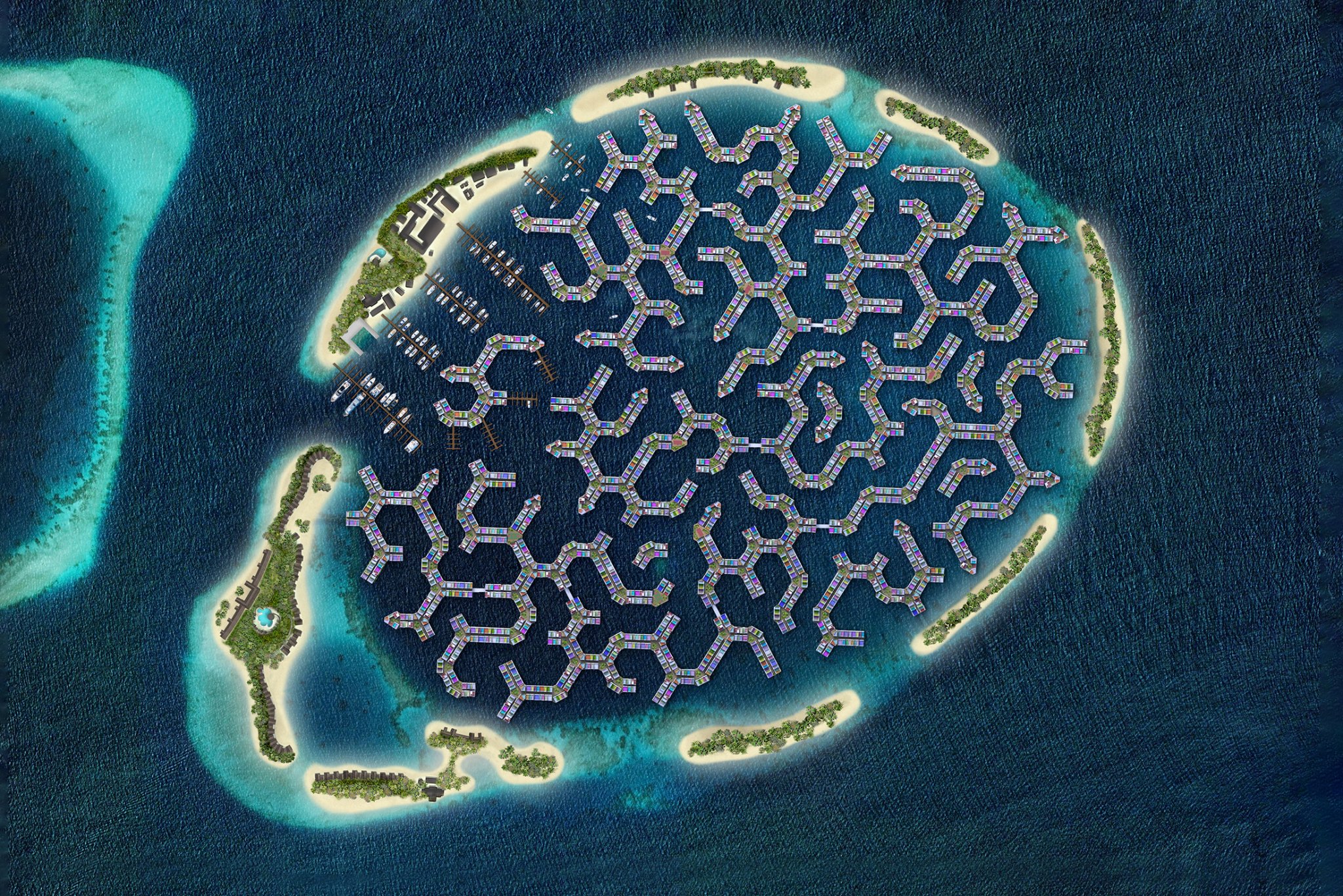
The Maldives Floating City project defines itself as " the first development of a new era in which Maldivians return to the water with resilient eco-friendly floating projects." This will be achieved by placing 5,000 homes along a flexible grid across a 200-hectare lagoon. Just ten minutes by boat from Malé, the Maldivian capital, the floating city project is in an advanced stage of development and the first residents are expected to arrive as early as 2024.
Who is behind the floating city project?
The Maldives Floating City has been designed by two architecture firms in the Netherlands, Waterstudio and Dutch Docklands. Their architectural expertise has led them to develop specific water-based urban planning integration solutions.
The design of the Maldives Floating City is based mainly on the shapes and outlines of a local coral called brain coral, the diploria labyrinthiformis. When viewed from above, the city will resemble the brain coral. The developers define the city as a "nature-based structure of roads and water canals."
Floating cities as a solution to rising sea levels

The Maldives Floating City is the first major step towards tackling an urgent problem. According to the World Bank, future sea levels are projected to increase in the range of 10 to 100 centimeters by the year 2100. With these estimates, the Maldives could be completely submerged.
This has led to action being taken. The floating city represents a major commitment that embraces sustainable and modular urbanization. Everything is designed from an environmental perspective. The city will be equipped with a smart energy grid powering the city solely with renewable energy. Furthermore, property prices are expected to stay below $250,000, in an attempt to attract local residents, rather than just building a residential complex for tourists.
All urban facilities and services have been taken into account in the design of the city. Apart from houses, the floating neighborhood will have shops and restaurants. Transport will be restricted to small electric vehicles and bikes. And, more importantly, the structure of the floating city will solve the issue of the threat posed by rising sea levels, withstanding future environmental crises.
Images | Waterstudio