Table of Contents
This is a guest post written by Giuseppe Masanotti, a Construction Engineer specialized in structural engineering. He is a member of the Urban planning Commission and of the Structural Safety Commission of the Turin Order of Engineers.
The Most Widely Used Mixture in the World and Its Environmental Impact
Each year, over 33 billion tons of concrete are produced globally, making it the most consumed material on the planet after water. Yet this essential component of urban development comes with a heavy price: the cement industry is responsible for approximately 8% of global CO₂ emissions, releasing 800 to 900 kg of CO₂ per ton produced.
As climate urgency grows and cities strive for smarter, greener futures, the construction sector must reinvent its materials. In this context, biochar is emerging as a transformative solution —a carbon-negative additive that could redefine the very foundations of future building and urban infrastructure.
What is Biochar?
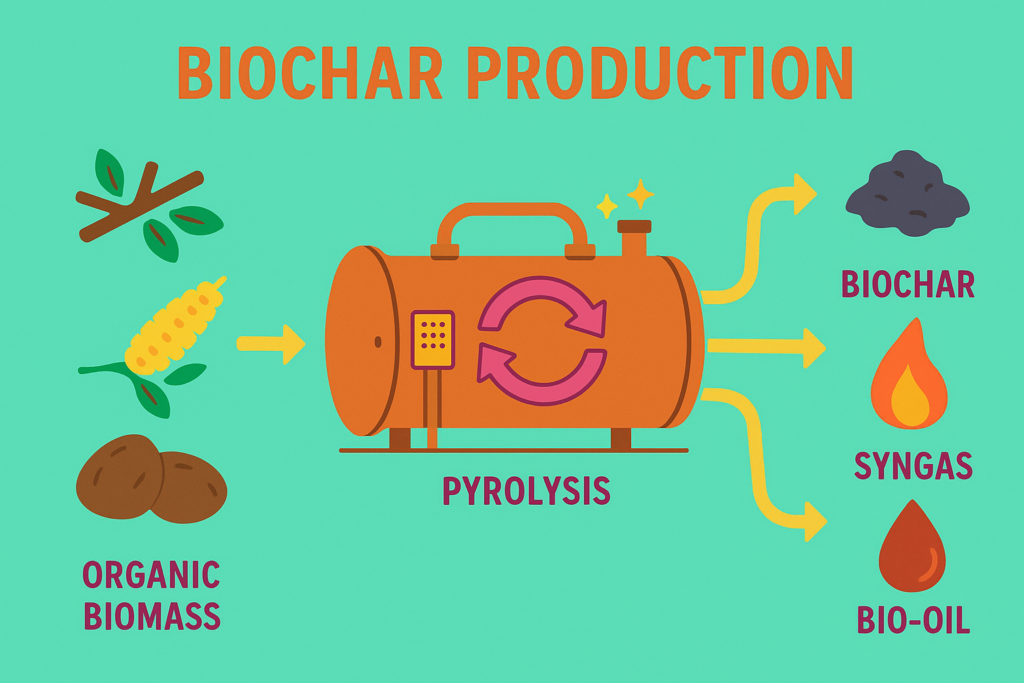
Biochar is a carbon-rich, porous substance produced through pyrolysis, a process that thermochemically decomposes organic biomass, such as agricultural residues or wood waste, in the absence of oxygen.
Originally used in agriculture to enhance soil fertility and retain water, biochar has recently caught the attention of material scientists and civil engineers for its potential to store carbon long-term, improve material performance, and support healthier built environments.
Why Add Biochar to Concrete?
Integrating biochar into cementitious materials offers a suite of benefits that are both environmental and technical:
Carbon Sequestration and Climate Impact
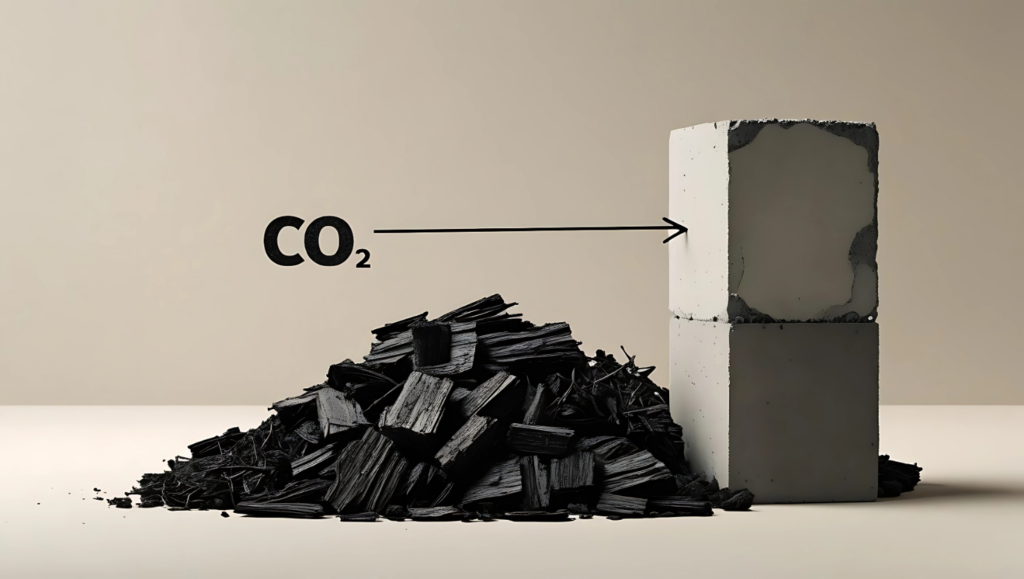
One of biochar’s most promising features is its ability to permanently lock away carbon. Just one ton of biochar can sequester up to 2.2 tons of CO₂, reducing emissions from cement production and contributing to the creation of net-zero or even carbon-negative construction materials.
By partially replacing cement clinker in concrete mixes, biochar helps lower emissions without compromising structural performance, making this one of the most promising strategies for decarbonizing the built environment.
Mechanical and Structural Advantages
Laboratory tests and pilot studies have shown that adding 1% to 3% of biochar by volume can:
- Maintain or even enhance compressive strength (up to +15%).
- Reduce water permeability, drying shrinkage, and microcracking.
- Improve long-term durability.
These effects vary depending on the biomass feedstock, pyrolysis temperature, and particle size of the biochar, allowing tailored formulations for specific applications and environments.
Enhanced Durability and Self-Healing Potential
Certain types of biochar, especially those derived from silica-rich residues like rice husk or bamboo, can exhibit pozzolanic behavior, reacting with calcium hydroxide in concrete to form additional calcium-silicate-hydrate (C-S-H) gel. This potentially strengthens the cement matrix and enhances resistance to chemical attack, freeze-thaw cycles, and chloride penetration.
Additionally, biochar’s porous structure can support calcifying bacteria, which stimulate the formation of calcium carbonate (CaCO₃) to fill and seal microcracks autonomously, a feature similar to self-healing materials.
Improved Indoor Air Quality
In sustainable architecture, attention is shifting from just energy use to indoor environmental quality. Here too, biochar offers unexpected advantages.
Thanks to its adsorptive surface chemistry, biochar can trap harmful volatile organic compounds (VOCs) like formaldehyde, benzene, and toluene. When used in panels, flooring substrates, or plasters, it contributes to cleaner, healthier indoor environments, particularly beneficial in energy-efficient buildings with limited ventilation.
What’s Holding Back Widespread Adoption?
Despite promising early results, the integration of biochar into structural concrete is not yet standard practice. The main obstacles are:
- Material variability: Biochar properties depend heavily on biomass type, pyrolysis conditions, and post-processing steps.
- Lack of standards: There are currently no unified technical standards (e.g., UNI or EN) governing the use of biochar in structural construction. Currently, there are only regulations accompanying experimentation.
- Design uncertainty: Engineers lack consistent, validated models to predict behavior over time, limiting the inclusion of biochar in mainstream design workflows.
Overcoming these barriers requires systematic investment in research, testing, and regulatory frameworks.
From Research to Implementation: Unlocking Biochar’s Potential
To transition biochar-enhanced concrete from experimental innovation to mainstream application, a coordinated effort across multiple disciplines is essential.
Robust, multi-sector research programs must bridge material science, to standardize production and understand long-term behavior, with civil and environmental engineering, where structural performance and lifecycle impacts can be rigorously tested under real-world conditions. Meanwhile, architects and urban designers must integrate these materials into functional, scalable, and aesthetic solutions that align with the demands of smart, sustainable cities.
Equally vital are pilot projects —from experimental buildings and test platforms to full-scale demonstrator infrastructures. These initiatives offer tangible proof-of-concept, helping to scale lab formulations to site-ready mixes, validate carbon-negative performance, and build public and industry confidence. By documenting and disseminating outcomes, they contribute to shared data repositories, case studies, and reference models essential for wider adoption.
To scale up effectively, this research ecosystem must be supported by:
- Internationally recognized technical standards, starting from voluntary protocols and evolving into building code integration.
- Real-world validation efforts, backed by universities, municipalities, and green building councils.
- Policy frameworks and procurement incentives that favor low-carbon materials in both public and private projects.
Only through this interplay between science, design, regulation, and demonstration can biochar concrete reach its full potential as a systemic tool for decarbonizing the built environment.
In particular, smart cities and public infrastructure projects offer ideal opportunities to lead the way, creating low-risk, high-impact showcases that demonstrate both the environmental and economic value of biochar-enhanced materials.
So, Let’s Build Smarter, Cleaner Cities with Biochar Concrete
Biochar concrete is more than a promising material innovation —it has the potential to become a systemic enabler of urban sustainability. It combines emissions reduction, material durability, and indoor air quality enhancement, while offering long-term carbon sequestration benefits.
As cities evolve to meet the challenges of resilience and intelligence, embracing such emerging technologies becomes an increasingly compelling choice.
While this shift won’t happen automatically, coordinated efforts in research, pilot implementation, and standardization can significantly accelerate progress. With the right support, we can begin to reshape the construction sector, which is now a major contributor to the climate crisis, into a key part of the solution.
Photos: Scott Blake, Stephen Cook, and Giuseppe Masanotti.