This is a guest post by EIT Urban Mobility written by Victoria Campbell. EIT Urban Mobility is the leading innovation community for urban mobility in Europe, committed to accelerating the transition to sustainable urban mobility and more liveable urban spaces.
Cities around the world are aiming to decarbonise their transportation systems in order to curb the impacts of climate change and create more resilient and sustainable futures for their residents. As part of that effort, an increased focus has been placed on increasing public transport ridership, and in particular, creating inclusive and accessible offerings for all.
However, while social and systemic barriers to public transport ridership have been studied across some demographic markers; such as gender, disability status, race, ethnicity, age and income; sexual orientation and gender-nonconforming identities have not received the same exploration. This gap in research is particularly pronounced when considering the risks of violence and intimidation that LGBTQ+ riders face when riding public transport.

London TravelWatch’s 2023 survey Out in London – LGBTQ+ people’s safety on the London transport network found that 21% of LGBTQ+ respondents experienced a hate crime on public transport within the previous year. Additionally, the survey found that 67% of respondents felt that “there is always a possible threat of violence or harassment when using public transport” and 43% reported that they often feel uneasy or “on edge” when using public transport.
While some European countries have made strides in expanding LGBTQ+ rights in recent years, others have removed protections and called LGBTQ+ (and particularly trans) identities’ legitimacy into question. From Hungary’s ban on Pride, to the United Kingdom’s Supreme Court ruling that the definition of sex is ‘binary’ and decided by biology, LGBTQ+ protections are being removed in just as many countries as they are being strengthened. The prevalence of such laws reinforces discriminatory attitudes and have implications on the perceived and actual safety of LGBTQ+ people in public spaces.
Action for public transport authorities
LGBTQ+ riders’ lack of adequately safe transport conditions can lead to a decrease in use, limiting their mobility and access to essential services like work, education and healthcare; as well as social opportunities integral to well-being. For LGBTQ+ youth without family support, older LGBTQ+ people facing isolation and trans individuals seeking gender-affirming care; access to public transport is paramount.
While federal laws are harder to change, there are numerous things that cities and public transport authorities can do to increase safety for LGBTQ+ riders. (It is also worth mentioning that the experiences of LGBTQ+ people vary widely based on innumerable factors, and intersectionality is important to take into consideration.)
Make LGBTQ+ visibility a year-round practice
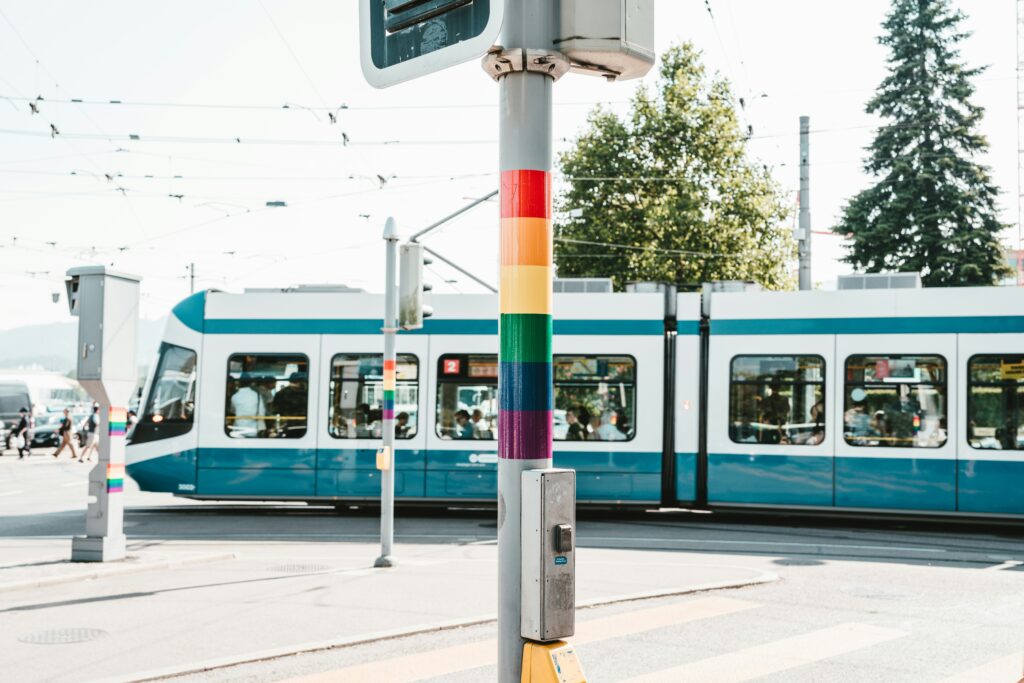
Celebrating Pride month with rainbow bus wraps, signage, or campaigns can send a strong message, but these displays should not be confined only to June. Long-term inclusivity campaigns, whether through social media, public service announcements or posters, can provide representation to LGBTQ+ folks, showing them they belong there. Additionally, such representation is important for all, as it makes the presence of diverse identities commonplace, thus fostering a culture of acceptance beyond just sexual orientation or gender identity.
Implement inclusivity training for staff
Public transport authorities should conduct regular training for all public transport staff, including drivers, conductors, ticket agents and security personnel; with a particular focus on how to recognise, intervene and report harassment and/or violence. Working with input from LGBTQ+ organisations can help public transport operators to understand the unique needs of the community and trainings could include bystander intervention techniques.
Encourage diverse hiring practices
Representation matters. When LGBTQ+ people see themselves reflected among transport workers, it can build trust and a sense of safety. Public transport operators should adopt inclusive workplace policies that protect and empower LGBTQ+ employees, while also implementing diverse recruitment policies to reach the next generation of public transport workers. LGBTQ+ individuals remain widely underrepresented in the sector, but involving people from a range of lived experiences, including trans individuals, is essential. When those most affected by transport systems are excluded from the planning process, their needs can easily be overlooked.
Improve reporting mechanisms
As police have historically been perpetrators of violence against the LGBTQ+ community (the Stonewall Uprising that sparked the modern LGBTQ+ rights movement was a police raid that turned violent, after all) new modes of reporting harassment and violence should be explored. Simplifying the reporting process and removing the need for police presence, through apps, text lines or anonymous tools can encourage more people to come forward. Importantly, all reports must be taken seriously and followed up with meaningful action.
Collect and use data thoughtfully
Cities and operators should collect anonymised data on harassment and discrimination in transport systems, broken down by gender identity and sexual orientation where possible. Additionally, deploying surveys to gather new information about feelings of safety can help to inform targeted interventions and track progress over time. Collaborating with LGBTQ+ advocacy groups can ensure data collection is ethical and impactful.
Lead with action
Some European cities have already begun to take more inclusive actions. Numerous cities wrap their buses and metros for Pride month but Transport for London has gone one step further to developed internal LGBTQ+ staff networks. Additionally, Transports Metropolitans Barcelona occasionally installs Purple Points (Punt Lila) in metro stations in order to “fight against any kind of sexist or LGTBI-phobic violence” by providing information and raising awareness. And, Berlin’s S Bahn has launched a QueerCityPass Berlin in which LGBTQI+ visitors can receive discounts on transit and over 70 participating businesses.
Visibility plays a powerful role in shifting public attitudes, but action is necessary year-round, not just during Pride month. While significant progress in Europe’s laws and policies protecting LGBTQ+ people is needed, public transport operators can do their part to make LGBTQ+ riders safer through initiatives that embrace the community.
Lastly, London TravelWatch’s survey found that 65% of respondents who experienced abuse or harm on public transport said bystanders witnessed the incident but did not step in to help. This highlights the role that riders can play in creating a safer transport environment, by speaking up against harassment and supporting policies and initiatives that promote inclusivity. Ensuring public transport is safe for everyone is a responsibility we all share.
Photos: EIT Urban Mobility, Vincenzo Inzone & Claudio Schwarz